विश्वास-प्रस्तुतिः
अथापरः १
English
Now the other type (of kūrmacit with rounded limbs).
मूलम्
अथापरः १
विश्वास-प्रस्तुतिः
पुरुषस्य षोडशीभिर्विंशशतं सारत्निप्रादेशः सप्तविधः सम्पद्यते २
English
120 (square) bricks of side equal to \(\frac{1}{16}\) purușa (ṣoḍaśī) give the area of the seven-fold (fire-altar of \(7\frac{1}{2}\) sq. purușa) with (two) aratnis and (one) prādeśa).
मूलम्
पुरुषस्य षोडशीभिर्विंशशतं सारत्निप्रादेशः सप्तविधः सम्पद्यते २
विश्वास-प्रस्तुतिः
तासां पञ्च षोडशीरपोद्धृत्य शेषाः परिमण्डलं करोति । तदुत्तरेण द्रोणचिता व्याख्यातम् ३
English
Of them 5 ṣoḍaśī bricks are taken away, and (the area equivalent to) the remaining (115 bricks) is transformed into a circle. This (kind of transformation into a circle) has been explained in the case of the fire-altar in the form of a trough of the second type.
मूलम्
तासां पञ्च षोडशीरपोद्धृत्य शेषाः परिमण्डलं करोति । तदुत्तरेण द्रोणचिता व्याख्यातम् ३
विश्वास-प्रस्तुतिः
अथ ताः पञ्च षोडश्यस्ताभि-रवान्तरदिक्षु पादानुन्नयेच्छिरः पुरस्तात् । तासां परिकर्षणं व्याख्यातम् ४
English
With 5 ṣoḍaśī bricks, (four) feet in (four) intermediate directions and the head in the east are to be raised. How to round off these bricks (for fitting with the circular body) has been explained.
English
THE CONSTRUCTION OF A FIRE-ALTAR IN THE FORM OF A TORTOISE-SECOND TYPE WITH ROUNDED LIMBS.
21.2-21-4. The construction. Here the method of construction is the same as that already described in the case of the circular trough (chapter 18). We have seen that 120 sodasi bricks equal \(7\frac{1}{2}\) sq. pu. 5 ṣoḍaśi bricks are taken out and the area of the remaining 115 ṣoḍaśis (103500 sq. aṅg.) is turned into a square of side 321 aṅg. 24 ti (the commentator’s value is 321 aṅg. 25 ti). This square is transformed into a circle of the same area as per Bśl. 2.9. In this act of circling the square, each of the 5 ṣoḍaśī bricks is cut by the circle and the western portion transferred to the eastern side. In this way, each of the 5 şoḍasi bricks is rounded off, one of them forms the head and the remaining 4 are attached to the circle in the 4 intermediate directions (Fig. 75).
The next step is to draw within the circle a square of the maximum possible area. The side of the inscribed square, as we have calculated, works out to 256 aṅg. 25 ti.
मूलम्
अथ ताः पञ्च षोडश्यस्ताभि-रवान्तरदिक्षु पादानुन्नयेच्छिरः पुरस्तात् । तासां परिकर्षणं व्याख्यातम् ४
विश्वास-प्रस्तुतिः
प्रधीनां सप्तधा विभागः प्रधिमध्यमाः प्रक्रमव्यासा भवन्ति ५
English
The (four) circular segments (obtained by drawing the maximum possible square within the above circle and after placing 6 bricks of side equal to (\frac{1}{12}\) of the side of the inscribed square on the base of the segment as in the case of the trough) are each divided into 7 parts. Bricks in the middle of the segments are each 1 prakrama (30 añgulas) wide.
मूलम्
प्रधीनां सप्तधा विभागः प्रधिमध्यमाः प्रक्रमव्यासा भवन्ति ५
विश्वास-प्रस्तुतिः
यदतिरिक्तं सम्पद्यते तच्चतुरश्राणामध्यर्धाभिर्योयुज्येत ६
English
The resulting bricks in excess (of 200) are adjusted by square bricks longer by half on one side (adhyardhā).
मूलम्
यदतिरिक्तं सम्पद्यते तच्चतुरश्राणामध्यर्धाभिर्योयुज्येत ६
विश्वास-प्रस्तुतिः
अपरस्मिन्प्रस्तारे पादानां शिरोवद्विभागः शिरसः पादवत् ७
English
In the other layer, the feet are divided in the same manner as the head (in the first layer) and the head is divided like the feet (as in the first layer).
मूलम्
अपरस्मिन्प्रस्तारे पादानां शिरोवद्विभागः शिरसः पादवत् ७
विश्वास-प्रस्तुतिः
व्यत्यासं चिनुयाद्यावतः प्रस्तारांश्चिकीर्षेत् ८
English
Alternating with each other as many layers as desired are to be constructed.
मूलम्
व्यत्यासं चिनुयाद्यावतः प्रस्तारांश्चिकीर्षेत् ८
विश्वास-प्रस्तुतिः
कूर्मस्यान्ते तनु पुरीषमुपदध्यान्मध्ये बहुलम् । एतदेव द्रोणे विपरीतम् ९
English
A little loose earth is to be placed on the edge of the tortoise (-shaped fire- altar) and a large quantity in the middle of it. In the (fire-altar in the form of) trough, the oposite is the case.
English
21.5-21.9. The side of the inscribed square, 256 aṅg. 25 ti is divided into 12 equal parts, and squared bricks are formed with side equal to each such part, that is, 21 aṅg. 13 ti which agrees with the value of the commentator (trayodaŝatilasahitaika- vimsatyanguleneṣṭakaḥ). But the commentator’s value of 255 aṅg. 19 ti for the side of the inscribed square is inaccurate inasmuch as it leads to 21 aṅg. and 10 ti as the side of the square brick and not 21 aṅg. 13 ti as mentioned.
As in the droṇacit, there are four segments. 6 one-twelfth bricks are placed in the middle of the segment in contact with the inscribed square and the remaining space is divided into 7 parts as shown in the Fig. 75. The breadth of the brick in the centre of the segment (pradhi-madhyamā) in between the square bricks and the circumference must be 1 prakrama or 30 aṅg. as in the droṇacit.
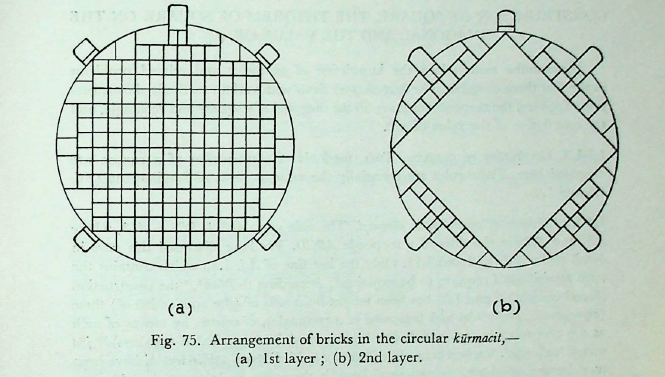
In the first layer, there are 144 square bricks inside the inscribed square, 24 square bricks in the segments and 28 bricks of different types in the remaining space of the pradhi. This makes 196 bricks. Now the pradhi-madhyama is pushed into the head and the vacant space thus created is filled with 2 bricks. The four feet are filled with 8 bricks of two types obtained in the process of cutting the sodasi square bricks by the circle of the body as referred to before. The total now becomes 206, that is, 6 bricks in excess of the required number of 200. This is adjusted by replacing 18 square bricks by 12 1 square bricks. (astädata caturasra uddhṛtya dvadasadhyardhestaka upadadhyāt).
In the second layer, the inscribed square is turned so that its four corners now point towards east, south, west and north. The placing of the bricks is the same as in the first layer with the difference that the placement of bricks in the feet is as in the case of the head of the first layer and that in the head as in the feet of the first layer. The adjustment is made as before.
The remaining sütras 21.10-21.13 do not call for much comment.
मूलम्
कूर्मस्यान्ते तनु पुरीषमुपदध्यान्मध्ये बहुलम् । एतदेव द्रोणे विपरीतम् ९
विश्वास-प्रस्तुतिः
अथ हैक एकविधप्रभृतीन्प्रौगादीन् ब्रुवते १०
English
According to some (teachers), the fire-altars beginning with the one-fold should be (in the form of) isosceles triangles.
मूलम्
अथ हैक एकविधप्रभृतीन्प्रौगादीन् ब्रुवते १०
विश्वास-प्रस्तुतिः
समचतुरश्रानेक आचार्याः । तस्य करण्या द्वादशेनेष्टकाः कारा-येत्तासामर्ध्याः पाद्याश्च ११
English
According to some other (teachers), (these should be in the form of) squares. Bricks are to be made with of the side of the square and half and quarter bricks thereof.
मूलम्
समचतुरश्रानेक आचार्याः । तस्य करण्या द्वादशेनेष्टकाः कारा-येत्तासामर्ध्याः पाद्याश्च ११
विश्वास-प्रस्तुतिः
अथाश्वमेधिकस्याग्नेः पुरुषाभ्यासो ना-रत्निप्रादेशानां १२
English
The increase (in the area) of the fire-altar for the aśvamedha (sacrifice) takes place by the purușa and not by (two) aratnis and (one) prādeŝa.
मूलम्
अथाश्वमेधिकस्याग्नेः पुरुषाभ्यासो ना-रत्निप्रादेशानां १२
विश्वास-प्रस्तुतिः
प्राकृतो वा त्रिगुणः । त्रिस्तावोऽग्निर्भवतीत्येकविंशोऽग्निर्भवतीत्युभयं ब्राह्मणमुभयं ब्राह्मणम् १३
English
This (aśvamedha fire-altar) is original and three times as large. Being three times as large, this fire-altar is twentyone-fold, and such is the tradition contained in both the Brāhmaṇas.
मूलम्
प्राकृतो वा त्रिगुणः । त्रिस्तावोऽग्निर्भवतीत्येकविंशोऽग्निर्भवतीत्युभयं ब्राह्मणमुभयं ब्राह्मणम् १३
इति बौधायनशुल्बसूत्रम्