विश्वास-प्रस्तुतिः
रथचक्रचितं चिन्वीतेति विज्ञायते १
English
According to tradition, a fire-altar in the form of a chariot wheel is to be constructed.
मूलम्
रथचक्रचितं चिन्वीतेति विज्ञायते १
विश्वास-प्रस्तुतिः
द्वयानि तु खलु रथचक्राणि भवन्ति साराणि च प्रधियुक्तानि च । अविशेषात्ते मन्यामहेऽन्यतरस्याकृतिरिति २
English
The chariot wheels are indeed of two types, e.g. those with spokes and those (formed) by the joining of circular segments (to a central square piece). In the absence of any distinction between the two, both are taken into consi- deration and described.
English - comment
THE CONSTRUCTION OF A FIRE-ALTAR IN THE FORM OF A CHARIOT WHEEL (RATHACAKRACITI)
16.1-16.2. Fire-altars in the form of a chariot-wheel are of two types: (a) a square piece with four circular segments attached one on each side so as to give the whole structure a circular shape, and (b) a circular wheel provided with spokes. Both types. are used for sacrificial purposes and are described in this chapter.
मूलम्
द्वयानि तु खलु रथचक्राणि भवन्ति साराणि च प्रधियुक्तानि च । अविशेषात्ते मन्यामहेऽन्यतर-स्याकृतिरिति २
विश्वास-प्रस्तुतिः
अथाग्निं विमिमीते । यावानग्निः सारत्निप्रादेश-स्तावतीं भूमिं परिमण्डलां कृत्वा तस्मिन्यावत्सम्भवेत्तावत्समचतुरश्रं कृत्वा तस्य करण्या द्वादशेनेष्टकाः कारयेत् ३
English
Now the (area of the) fire-altar is measured out. A circle of area equal to that of the (seven-fold) fire-altar with (two) aratnis and (one) prādeśa is made, the largest possible square is inscribed in it, and bricks are made with the twelfth part of its side.
English - comment
THE CHARIOT WHEEL WITH CIRCULAR SEGMENTS.
16.3. The construction and brick types. The method of constructing a circle equivalent to that of a square area, in this case \(7\frac{1}{2}\) sq. pu., has been given in rule 2.9 and has already been discussed. Fig. 59 represents the required circle of area \(7\frac{1}{2}\) sq. pu., within which is drawn the largest possible square ABCD. The space bounded by each side of the square and the arc of the circle is called pradhi (segment); there are four such segments.

Let the side of the square AB or AD be a and the radius of the circle AO be r.
\(r = \sqrt{\frac{15\times 120 \times 120}{2π}}aṅg.\)
\(= 185.45 aṅg. or 185 aṅg. 15 ti.\)
Again, \(a^2 = 2r^2 = \frac{2 \times 15 \times 120 \times 120}{π}\)
or a \(= = \sqrt{\frac{15\times 120 \times 120}{π}}\)
= 262.27 or 262 aṅg. 9 ti.
In the above calculations, π has been taken to be 3.14. D. gives the value of r as 185 aṅg. 14 ti. (madhye śańkum nihatya pañcāśītiśatāñngulena caturdaśatilayuktena pariman- dala bhramayet). His value of a is 262 aṅg. 7 ti (tasya madhye viskambhārdhadvikaraṇyā (r \(\sqrt{2}\) saptatiladhikayā dviṣaṣṭiśatadvayāngulayā samacaturaśram kuryāt). It appears that in giving these values Dvārakānātha used the more approximate correct value of π.
The square bricks are then made with each side equal to the twelfth part of AD, which, according to D’s value of the side of the inscribed square, is 21 aṅg. 29 ti (that is, 22 aṅg- 5 ti).
मूलम्
अथाग्निं विमिमीते । यावानग्निः सारत्निप्रादेश-स्तावतीं भूमिं परिमण्डलां कृत्वा तस्मिन्यावत्सम्भवेत्तावत्समचतुरश्रं कृत्वा तस्य करण्या द्वादशेनेष्टकाः कारयेत् ३
विश्वास-प्रस्तुतिः
तासां षट् प्रधावुपधाय शेषमष्टधा विभजेत् ४
English
6 of these (bricks) are placed in each circular segment and the remaining space (of the segment) is divided into 8 parts.
मूलम्
तासां षट् प्रधावुपधाय शेषमष्टधा विभजेत् ४
विश्वास-प्रस्तुतिः
अपरं प्रस्तारं तथोपदध्याद्यथा प्रध्यनीकेषु स्र-क्तयो भवन्ति ५
English
The other layer is to be so oriented that the corners (of the square) lie in the centres of the segments (of the first layer).
English
16.4-16.5. Placement of bricks. 144 bricks of the type mentioned above can be placed within the square ABCD. In the segments, 6 such bricks are placed adjoining the middle side of the square and the remaining space is divided into 8 parts (Fig. 60 (a), (b)). Thus each segment contains 14 bricks and four segments account for 56 bricks, making the total number 200. Regarding the placement of bricks in each segment, D. explains as follows: pradhimulamadhye ṣaț caturaśră upadhāya tasya pradheḥ sesamaṣṭadhā vibhajet | upahitānām ṣaṇṇām pārsvayordve dve mukhe catasra iti |
D. also gives the measurements of these eight bricks as follows (only four will do):
(1) The corner brick abg : ab = 33 aṅg. — 7 ti; bg = 26 aṅg + 3 ti ;
ag = 42 aṅg — 3 ti ;
(2) The 4 sided brick bchg: bc = 33 aṅg. — 7 ti ; ch = 42 aṅg + 11 ti ; hg = 36 aṅg + 26 ti ; bg = already given.
(3) The 4 sided brick deih : de = 33 aṅg — 7ti ; ei = 30 aṅg — 16ti;
ih = 34 aṅg.; hd = \(20\frac{1}{2}\) aṅg.
(4) The 4 sided brick efji: ef = 33 aṅg. — 7 ti; fj = \(32\frac{1}{2}\) aṅg. ;
ji = 33 aṅg. — 4 ti; ei already given.
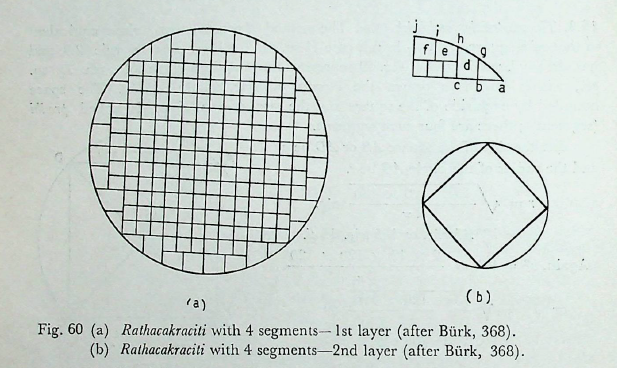
Fig. 60 (a) Rathacakraciti with 4 segments- 1st layer (after Bürk, 368).
(b) Rathacakraciti with 4 segments- 2nd layer (after Bürk, 368).
ag, hg, ih and ji are curved. D. neglected the curvature of ag, but considered the rest by giving the values of the śara, the distance between the centre of the arc and the respective chord in each case. For hg, ih and ji, these values are 31 ti; 26 ti., and 25 ti. respectively. Calculation of arcs and their saras were obviously consi- dered important mathematical exercises in medieval India when these commentaries were prepared.
In the second layer the inscribed square is turned such that its corner lies in the centre of each segment of the first layer in order to avoid the overlapping of the edges of the bricks between layers.
मूलम्
अपरं प्रस्तारं तथोपदध्याद्यथा प्रध्यनीकेषु स्र-क्तयो भवन्ति ५
विश्वास-प्रस्तुतिः
अथापरः ६
English
Now the other type.
मूलम्
अथापरः ६
विश्वास-प्रस्तुतिः
पुरुषार्धात्पञ्चदशेनेष्टकाः समचतुरश्राः कारयेन्मानार्थाः ७
English
Square bricks of area equal to the fifteenth part of half a (square) puruşa are made for purposes of measurement.
मूलम्
पुरुषार्धात्पञ्चदशेनेष्टकाः समचतुरश्राः कारयेन्मानार्थाः ७
विश्वास-प्रस्तुतिः
तासां द्वे शते पञ्चविंशतिश्च सारत्निप्रादेशः सप्तविधः सम्पद्यते ८
English
With 225 of them (of such bricks) is accomplished the seven-fold (fire- altar) with (two) aratnis and (one) prādeśa.
मूलम्
तासां द्वे शते पञ्चविंशतिश्च सारत्निप्रादेशः सप्तविधः सम्पद्यते ८
विश्वास-प्रस्तुतिः
तास्वन्याश्चतुःषष्टिमावपेत् । ताभिः समचतुरश्रं करोति । तस्य षोडशेष्टका पार्श्वमानी भवति । त्रयस्त्रिंशदतिशिष्यन्ते । ताभिरन्तान्सर्वशः परिचिनुयात् ९
English
To these (225 bricks) another 64 (bricks of the same kind) are added and with them (289 bricks) a square is made (as follows). (At first) a square is made with a side containing 16 bricks (in which 256 bricks are used up), leaving a balance of 33 bricks. These (33 bricks) are placed on all sides (actually on two adjoining sides, so as to obtain a square of side containing 17 bricks).
मूलम्
तास्वन्याश्चतुःषष्टिमावपेत् । ताभिः समचतुरश्रं करोति । तस्य षोडशेष्टका पार्श्वमानी भवति । त्रयस्त्रिंशदतिशिष्यन्ते । ताभिरन्तान्सर्वशः परिचिनुयात् ९
विश्वास-प्रस्तुतिः
नाभिः षोडश मध्यमाः । चतुःष-ष्टिरराश्चतुःषष्टिर्वेदिः । नेमिः शेषाः १०
English
16 (bricks) at the centre constitute the nave; 64 (bricks thereafter) constitute the spokes and 64 the empty spaces (between spokes); the remaining (145 bricks) form the felly.
मूलम्
नाभिः षोडश मध्यमाः । चतुःष-ष्टिरराश्चतुःषष्टिर्वेदिः । नेमिः शेषाः १०
विश्वास-प्रस्तुतिः
नाभिमन्ततः परिलिखेत् । नेमिमन्ततश्चान्तरतश्च परिलिख्य । नेमिनाभ्योरन्तरालं द्वात्रिंशद्धा वि-भज्य विपर्यासं भागानुद्धरेत् । एवमावाप उद्धृतो भवति ११
English
(The square shaped) nave at its borders is transformed into a circle (by the method previously described). The outer and the inner (squares) enclosing the felly are transformed into (two) circles. After dividing the space between the felly and the nave into 32 equal parts, the alternate ones are removed. In this way, the added area (equivalent of 64 bricks) stands withdrawn.
English - comment
THE CHARIOT WHEEL WITH SPOKES.
16.6-16.11. The measurement and the construction of the wheel. For purposes of measure- ment of a wheel of this type, square bricks each of area sq. pu. are used.
The total area of the fire-altar, \(\frac{15}{2}\) sq. pu. will therefore involve \(\frac{15 \times 30}{2}\) or 225 bricks. The side of each brick a is given by :
\(a = \sqrt{\frac{120 \times 120}{30}} = \sqrt{480} aṅg = 21 aṅg. 31 tila\)
This agrees with the value given by D. msattilaḥ | teneṣṭakaḥ samacaturaśrāḥ kārayet |
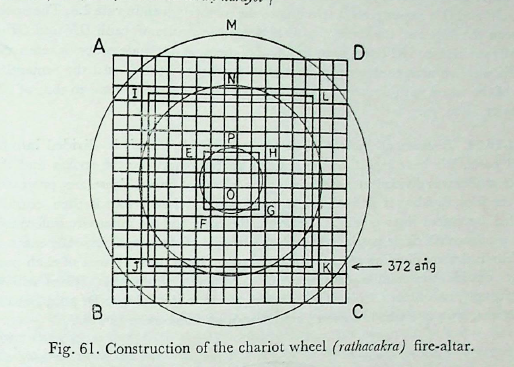
Fig. 61. Construction of the chariot wheel (rathacakra) fire-altar.
Now, 225 is a squared number 15^2. A chariot wheel with spokes consists of the central circular part, the nave, the spokes and the outer circular rim, the felly. The spokes connecting the nave and the felly alternate with empty spaces. In the procedure suggested, an area equivalent to the empty spaces between spokes is first added and then removed. This area is here taken to be equivalent to that of 64 square bricks of the type described above, probably because 225 plus 64 make 289, a squared number 17^2. Hence the direction of arranging 289 bricks in the form of a square so that each side contains 17 bricks. This is done in two stages; at first 256 bricks are arranged in a square, each side containing 16 bricks, and then 33 bricks, -17 plus 16, are placed along two adjoining sides. In this way the square ABCD is formed (Fig. 61 ).
In the central region of the above square, another square EFGH of 16 bricks is formed. As D. explains, it is constructed out of the central square of 25 bricks by putting 4 poles, one each at the centre of the corner bricks, at E, F, G and H, and then joining them. The square EFGH forms the nave (nābhi).
In the same manner, another square IJKL is formed of 144 bricks, centrally placed within ABCD. This is again done out of a square of 169 bricks, each side containing 13 bricks. A pole is placed at the centre of each of the four corner bricks, I, J, K and L, and these poles are joined. The area between the squares IJKL and EFGH is equivalent to the area of 128 (144-16) bricks, half of which, that is, 64, is used for making the spokes (arā) and the remaining half (64 bricks) for the empty spaces (vedi).
The space between the squares ABCD and IJKL, equivalent to 145 (289-144) bricks constitutes the felly (nemi).
Then three squares ABCD, EFGH and IJKL are turned into circles of radii OM, OP and ON respectively, according to the method given in rule 2.9. The space between the felly and the nave, that is between the circles of radii ON and OP is radially divided into 32 equal parts and half of them, in alternate order, is removed. In this way, an area equivalent to that of 64 bricks is rejected, and the remaining area of the wheel with the nave, spokes and the felly is exactly equal to that of 225 bricks or \(7\frac{1}{2}\) sq. pu.
मूलम्
नाभिमन्ततः परिलिखेत् । नेमिमन्ततश्चान्तरतश्च परिलिख्य । नेमिनाभ्योरन्तरालं द्वात्रिंशद्धा वि-भज्य विपर्यासं भागानुद्धरेत् । एवमावाप उद्धृतो भवति ११
विश्वास-प्रस्तुतिः
नेमिं चतुःषष्टिं कृत्वा व्यवलिख्य मध्ये परिकृषेत् । ता अष्टाविंशतिशतं भवन्ति १२
English
After dividing the felly into 64 equal parts and drawing (radial) lines (through these divisions), a circle is drawn through the middle (of the felly), making the number (of parts in the felly) equal to 128.
मूलम्
नेमिं चतुःषष्टिं कृत्वा व्यवलिख्य मध्ये परिकृषेत् । ता अष्टाविंशतिशतं भवन्ति १२
विश्वास-प्रस्तुतिः
अरांश्चतुर्धा चतुर्धा नाभिमष्टधा विभजेत् १३
English
The spokes are each divided into 4 parts; the nave is divided into 8 parts.
मूलम्
अरांश्चतुर्धा चतुर्धा नाभिमष्टधा विभजेत् १३
विश्वास-प्रस्तुतिः
एष प्रथमः प्रस्तारः १४
English
This is the first layer (of 200 parts or bricks).
English - comment
16.12-16.14. Placement of bricks in the first layer. The felly (nemi) is divided into 64 equal parts. We have seen that the annular space comprising the spokes and the empty spaces was divided into 32 equal parts by radial lines. These are projected into the felly, dividing it at first into 32 equal parts, and each part is then equally divided by radial lines confined between the outer and the inner circumference. Now a concentric circle passing through the middle of these two circumferences of the felly is drawn, dividing its space into 128 parts. Note that the area of each part lying outside the middle circumference is different from that lying within. Accordingly, two types of bricks are required to cover the felly, as D. points out – hāhyāścatuḥṣaṣṭi | tāsāmekam karaṇam | antataścatuḥṣaṣṭi | tāsāmekam karaṇam |
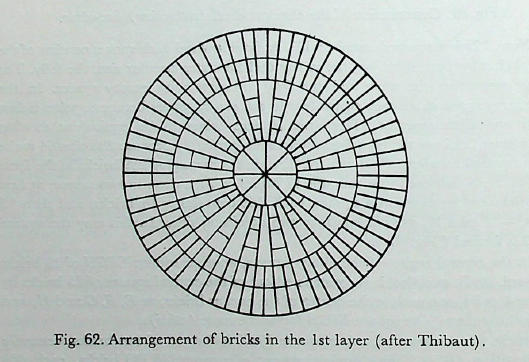
Fig. 62. Arrangement of bricks in the 1st layer (after Thibaut).
Each spoke is divided into 4 parts, thereby involving the use of 64 bricks of four different types. Finally the nave is divided into 8 equal parts to make the total number of bricks in the first layer 200. Thus seven different types of bricks are required to cover the first layer-evam sapta karaṇāni | eṣa prathamaḥ prastāraḥ | evam fatadvayasampattiḥ -D.
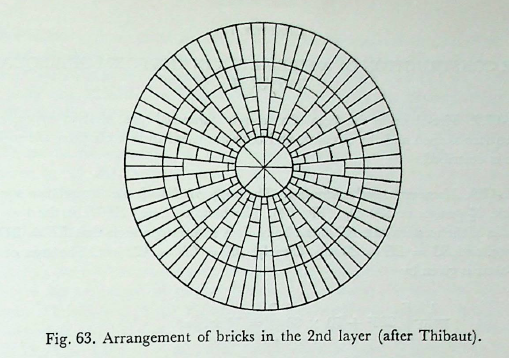
Fig. 63. Arrangement of bricks in the 2nd layer (after Thibaut).
मूलम्
एष प्रथमः प्रस्तारः १४
विश्वास-प्रस्तुतिः
अपरस्मिन्प्रस्तारे नाभिमन्ततश्चतुर्थवेलायां परिकृषेत् । नेमिमन्तरतः १५
English
In the other layer, a circle is to be drawn within the nave at a distance equal to one-fourth (of the radius) from its inner edge. The same (is to be done) within the felly (at a distance equal to one-fourth of the felly’s breadth) from the inner circumference.
मूलम्
अपरस्मिन्प्रस्तारे नाभिमन्ततश्चतुर्थवेलायां परिकृषेत् । नेमिमन्तरतः १५
विश्वास-प्रस्तुतिः
नेमिमन्तरतश्चतुःषष्टिं कृत्वा व्यवलिखेत् १६
English
After dividing the inner edge of the felly (that is, the circle drawn within it) into 64 equal parts, (radial) lines are to be drawn (so as to divide the felly into 64 parts).
मूलम्
नेमिमन्तरतश्चतुःषष्टिं कृत्वा व्यवलिखेत् १६
विश्वास-प्रस्तुतिः
अराणां पञ्चधा विभाग आपरिकर्षणयोः १७
English
(The space in each of) the spokes is divided into 5 parts from circle (in the nave) to circle (in the felly).
मूलम्
अराणां पञ्चधा विभाग आपरिकर्षणयोः १७
विश्वास-प्रस्तुतिः
नेम्यामन्तरालेषु द्वे द्वे नाभ्यामन्त-रालेष्वेकैकां १८
English
The space in each interstice of the felly is divided into 2 parts, and there is 1 part in each interstice of the nave.
मूलम्
नेम्यामन्तरालेषु द्वे द्वे नाभ्यामन्त-रालेष्वेकैकां १८
विश्वास-प्रस्तुतिः
यच्छेषं नाभेस्तदष्टधा विभजेत् १९
English
The remaining space of the nave is to be divided into 8 parts.
मूलम्
यच्छेषं नाभेस्तदष्टधा विभजेत् १९
विश्वास-प्रस्तुतिः
स एष षोडशकरणः सारो रथचक्रचित् २०
English
These are the 16 types (of bricks required) in (the construction of) the fire-altar in the form of a chariot wheel with spokes.
English - comment
16.15-16-20. Placement of bricks in the second layer. The general principle of avoiding overlapping of cleavages of bricks in the two layers is to be kept in view. For this reason, a circle shorter by one-fourth ( OP) is drawn within the nave; its distance from the edge is therefore a quarter. In the felly, a concentric circle is drawn so that its distance from the inner edge is one-fourth the breadth of the felly (nemimabhyan- tarato nemipramāṇacaturthabhāge’tite parikṛṣet—D.)
The annular space of the felly between this new circle and the outermost one is divided into 64 equal parts and filled with bricks of one type. Each of the 16 spokes extending from the newly drawn inner circle in the nave upto the newly drawn inner circle of the felly is divided into 5 parts and 5 different types of bricks are used. The spokes will thus involve the use of 80 bricks. In between spokes, in the region of the felly, there are 16 spaces, each of which is divided into two equal parts, and 32 bricks of another type are used to fill them up (arāṇāmantarāleṣu vedipradeśasamipe nemyām dve dve iṣṭake | ….tāsāmṣkam karaṇam | tā dvātriṛśat—D.). Likewise, there are 16 spaces in the nave between the spokes and outside the inner circle; 16 bricks of another size are used to cover them. The remaining central part of the nave is radially divided into 8 parts and 8 bricks of still another type are employed to cover them. In this way, the total number of 200 (64 + 80 + 32 + 16 + 8) bricks of 9 different types are used. With the 7 types used for the first layer, and 9 for the second 16 different types of bricks are used to construct the fire-altar in the shape of a chariot wheel with spokes.
मूलम्
स एष षोडशकरणः सारो रथचक्रचित् २०