विश्वास-प्रस्तुतिः
उभयतः प्रौगं चिन्वीतेति १
English
A fire-altar in the form of a rhombus (made of two isosceles triangles, (ubhayata prauga) is to be constructed as follows.
मूलम्
उभयतः प्रौगं चिन्वीतेति १
विश्वास-प्रस्तुतिः
यावानग्निः सारत्निप्रादेशस्तावदुभयतः प्रौगं कृत्वा नवमेन तिर्यङ्मान्याः प्रौगचितोक्ता विकाराः २
English
A rhombus equal in area to the (seven-fold) fire-altar with (two) aratnis and (one) prādesa (that is, \(1\frac{1}{2}\) sq. puruṣa) is laid. As in the case of fire-altar in the form of isosceles triangle, bricks and their variations are to be made with the ninth part of the breadth (of the rectangle used for the construction of the rhombus).
English - comment
THE CONSTRUCTION OF A FIRE-ALTAR IN THE FORM OF A RHOMBUS (UBHAYATA PRAUGA)
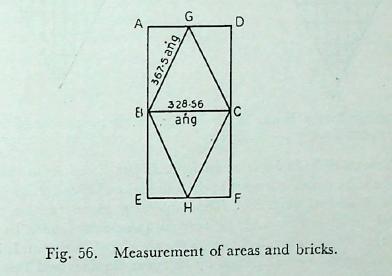
15.2. The construction and the types of bricks. The method of construction of a rhombus or double isosceles triangle having common base and the two vertices on the opposite sides is given in Bśl. 2.8. ABCD and BEFC are two equal squares, each of area \(7\frac{1}{2}\) sq. pu. GBHC is the desired rhombus of \(7\frac{1}{2}\) sq. pu. of which G and H are the mid-points of AD and EF respectively.
\(BC = 120\sqrt{\frac{15}{2}} aṅg 328.56 aṅg.\)
\(BG = GC = BH = HC = 300 \sqrt{\frac{1}{2}} aṅg. - 367.5 aṅg. \)
D. gives the value of BC as: triņi satānyaṣṭāvimśatiścāngulaya ardhaviṁśāśca tilāḥ (.56 aṅg. 19.04 tila) tiryaṁmāni. Each side of the rhombus is given as evam kṛte’- rdhādhikasaptaṣaştiśatatrayamaṅgulayaḥ karaṇyo bhavanti.
Four types of bricks are made in the same way as those for the isosceles fire- altar (14.2). \(B_{1}\), the rectangular brick, bṛhati, is \(\frac{BC}{9}\times \frac{BC}{18}\); brics \(B_{2}\) (ardhyā), \(B_{3}\) (dirghapādyā) and \(B_{4}\) (śūlapādyā) are made by diagonal intersections of the br̥hati as before.
मूलम्
यावानग्निः सारत्निप्रादेशस्तावदुभयतः प्रौगं कृत्वा नवमेन तिर्यङ्मान्याः प्रौगचितोक्ता विकाराः २
विश्वास-प्रस्तुतिः
तथोपधानम् ३
English
The placement (of bricks in the first layer) is the same as before (as that of the isosceles triangle).
English - comment
15.3. Placement of bricks in the first layer. BC is divided into 18 equal parts and marked and likewise GH in 18 equal parts and marked. Lines parallel to BC and GH are drawn. It is easily seen that the entire area is divided into 144 rectangles where an equal number of bṛhati bricks can be placed and into 36 half rectangles along the sides where an equal number of ardhyās can be placed. Thus we get 180 bricks. The deficit is met by replacing 10 \(B_{1}s\) in the 6th vertical row on either side of the central line GH by 20 \(B_{2}s\). With the above substitution, the total number of \(B_{1}s\) is 124 and that of \(B_{2}s\) 76. On these points, the commentary runs as follows : ṣaṣṭhi dvādaśeṣ- takā tatra madhyāddaśa bṛhatirudhṛtya vimśatirardhyāḥ….asminprastāre caturvimśatisatam bṛhatyaḥ | satsaptatirardhyāḥ |
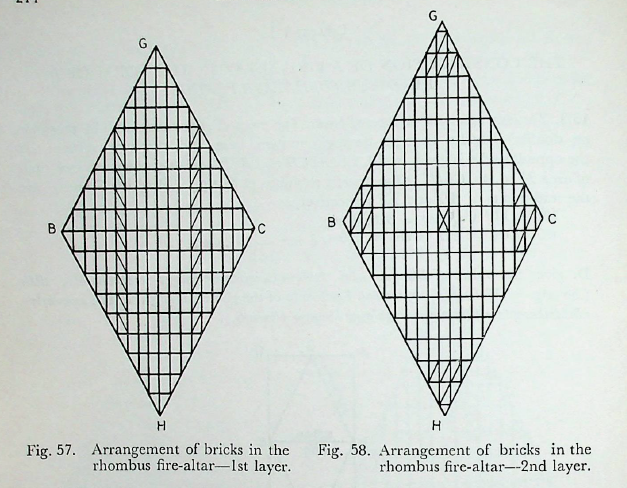
Fig. 57. Arrangement of bricks in the rhombus fire-altar–1st layer.
Fig. 58. Arrangement of bricks in the rhombus fire-altar-2nd layer.
मूलम्
तथोपधानम् ३
विश्वास-प्रस्तुतिः
अपरस्मिन्प्रस्तारे चुबुकयोर्द्ध्वे पादेष्टके उपदध्यात् । सन्ध्यन्तयोश्च दीर्घपाद्ये ४
English
In the second layer, 2 (short-based) quarter bricks are to be placed in the apices and 2 (wide-based) quarter bricks at the meeting places (of the two isosceles triangles).
मूलम्
अपरस्मिन्प्रस्तारे चुबुकयोर्द्ध्वे पादेष्टके उपदध्यात् । सन्ध्यन्तयोश्च दीर्घपाद्ये ४
विश्वास-प्रस्तुतिः
दीर्घे चेतरे च चतस्रः स्वयमातृण्णावकाश उपदध्यादर्ध्याश्चान्तयोः ५
English
4 quarter bricks, -2 wide-based (dirgha-pādyā) and 2 of the other type (sulapadya) are to be placed in the space of the svayamatṛṇna and half bricks on the two sides.
मूलम्
दीर्घे चेतरे च चतस्रः स्वयमातृण्णावकाश उपदध्यादर्ध्याश्चान्तयोः ५
विश्वास-प्रस्तुतिः
शेषमग्निं बृहतीभिः प्राचीभिः प्रच्छादयेदर्धेष्टकाभिः सङ्ख्यां पूरयेत् ६
English
The rest of the fire-altar is to be covered with bṛhati bricks (with length) turned towards east, and the number (of 200 bricks) is to be completed with half bricks.
English - comment
15.4-15.6. Placement of bricks in the second layer. As per directions in the rules, 2 \(B_{4}s\) (sūlapādyā) are to be placed one each at the apices G and H and 2 \(B_{3}s\) (dirghapādyā), one each at B and C (Fig. 58). The remaining space can be divided into 17 horizontal (south-north) and 17 vertical (west-east) rows. In the middle (svayamātṛṇṇa) of the fire-altar, 2 \(B_{3}s\) and 2 \(B_{4}s\) are placed as shown. It is easy to see that the remaining space can be filled by 32 \(B_{2}s\) at the sides and 144 \(B_{1}s\) with the longer side turned east or west. This accounts for 184 bricks. The number is completed by replacing 16 B1s, four each of the four directions, by 32 B2s. The total number of bricks of different types are: \(B_{1} — 128; B_{2} 64; B_{3} — 4; B_{4} — 4.\)
D. comments as follows: pūrvapaścimacubukayerdve sulapadye madhye saptadasodicyo ritayaḥ | sarvatra prāgāyatā iṣṭakāḥ | madhye bṛhatyaḥ | anteṣvardhyāḥ | dakṣiņottarasrakta- yordirghapādye | madhyamāyām rityām madhyamāyāḥ sthāne pūrvavatрādyāḥ | catasṛṣu dikṣu catasraścatasro bṛhatiruddhṛtyāṣṭāvaṣṭāvardhyā nidheyāḥ | evam dviśataḥ prastāraḥ | asminprastāre’ṣṭāvimśatiśatam bṛhatyaḥ | catuḥ ṣaṣṭirardhyāḥ | catasraḥ śūlapādyāḥ | catasro dirghapādyāḥ!
मूलम्
शेषमग्निं बृहतीभिः प्राचीभिः प्रच्छादयेदर्धेष्टकाभिः सङ्ख्यां पूरयेत् ६