विश्वास-प्रस्तुतिः
प्रौगचितं चिन्वीतेति १
English
A fire-altar in the form of an isosceles triangle (prauga) is to be constructed as follows.
मूलम्
प्रौगचितं चिन्वीतेति १
विश्वास-प्रस्तुतिः
यावानग्निः सारत्निप्रादेशस्तावत्प्रौगं कृत्वा तस्यापरस्याः करण्या द्वादशेनेष्टकास्तदर्धव्यासाः कारयेत् । तासामर्ध्याः पाद्याश्च २
English
An isosceles triangle equal in area to the (seven-fold) fire-altar with (two) aratnis and (one) pradeśa (that is, 7 sq. purușa) is laid. Bricks (called bṛhati) of length equal to one-twelfth of its western side and breadth equal to half (of the length) are to be made; then bricks which are half and quarter (of the bṛhatīs).
English - comment
THE CONSTRUCTION OF A FIRE-ALTAR IN THE FORM OF AN ISOSCELES TRIANGLE (PRAUGACITI)
14.2. Measurement of the fire-altar and the types of bricks. The area of the fire-altar should be \(7\frac{1}{2}\) sq. pu. Under rule 2.7, Baudhayana has shown that an isosceles triangle of \(7\frac{1}{2}\) sq. pu. can be drawn from a square of double this area, that is, 15 sq. pu., by joining the mid-point E of the eastern side AD with two western corner points B and C (Fig. 52). The base BC and each side EB, EC are given by
\(BC= \sqrt{15}\) pu.
\(=120\sqrt{15}\) ang.
\(= 464.76 or 464\frac{3}{4}\) ang. approx.
\(EB = EC = 300 √3 ang. = 519.6 or 519\frac{1}{2} ang.\)
D. therefore explains that a square with 4642 ang. (= 465 ang) is to be first drawn and the required isosceles triangle constructed, as already stated, in the following terms: tasyā dvikaraṇī pādonapañcaṣaṣṭicatuḥśatāngulā (4643 ang) dvistāva- tyāścaturaśrakṛtāyāḥ pañcadaśapuruṣāyā bhūmeḥ karaņi | evam caturaśrīkṛtāyāḥ pūrvasyāḥ karaṇyā madhyācchroṇi pratyālikhet | tatra karṇarūpayoḥ pramāṇamardhonaviṁśatipañcaśatāṅgulayaḥ (5191 ang.) | tasya praugasyāparasyāḥ karaṇyāḥ pādonapañcaṣaşṭicatuḥśatāṅgulāyā…… |
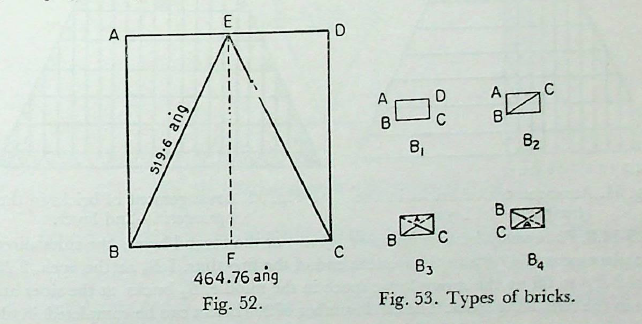
Fig. 53. Types of bricks.
The following four types of bricks are prescribed (Fig. 53):
\(B_{1}\) —a rectangular brick, bṛhati, \(\frac{BC}{12}\times \frac{BC}{24} or 10\sqrt{15}\times 5\sqrt{15}\)sq. aṅg.
\(B_{2}\) —a triangular brick half of the brhati, diagonally intersected.
\(B_{3}\) —a triangular quarter brick with long base, dirghapādyā.
\(B_{4}\) —a triangular quarter brick with short-base and pointed like a spear, śūlapādyā.
मूलम्
यावानग्निः सारत्निप्रादेशस्तावत्प्रौगं कृत्वा तस्यापरस्याः करण्या द्वादशेनेष्टकास्तदर्धव्यासाः कारयेत् । तासामर्ध्याः पाद्याश्च २
विश्वास-प्रस्तुतिः
तासां द्वे अर्धेष्टके बाह्यसविशेषे चुबुक उपदध्यादर्ध्याश्चान्तयोः ३
English
Of them, two half bricks with their hypotenuses turned outwards are to be placed in the apex and half bricks on both sides.
मूलम्
तासां द्वे अर्धेष्टके बाह्यसविशेषे चुबुक उपदध्यादर्ध्याश्चान्तयोः ३
विश्वास-प्रस्तुतिः
शेषमग्निं बृहतीभिः प्रच्छादयेदर्धेष्टकाभिः सङ्ख्यां पूरयेत् ४
English
The rest of the fire-altar is to be covered with bṛhati and the number (of 200 bricks) is to be completed with half bricks.
English - comment
14.3-14.4. Placement of bricks in the first layer. All that these two rules say is that half bricks with their hypotenuses turned outside are to be placed on both sides and bṛhati bricks in the remaining space. It is easy to see that 200 bricks cannot be used to cover the altar in this way. The way it can be done is explained in the commentary.
The praugaciti is divided into 24 rows west-east (Fig. 54), 12 on each side of the perpendicular line from the vertex to the middle of the base, and marked 1, 2, 3………….. 12. Bricks are placed as follows :—
In the 1st row on each side —\(B_{2} — 2;\) total — 2
In the 2nd row on each side —\(B_{2} — 6;\) " — 6
In the 3rd-10th row on each side
(that is 16 rows) —\(B_{1} — 88; B_{2} — 16;\) " — 104
In the 11th row on each side —\(B_{2} — 42;\) " — 42
In the 12th row on each side —\(B_{2} — 46;\) " — 46
Total : —\\(B_{1} = 88; B_{2} — 112;\\) 200

Fig. 54. Arrangement of bricks in the praugaciti 1st layer.
Fig. 55. Arrangement of bricks in the praugaciti 2nd layer.
मूलम्
शेषमग्निं बृहतीभिः प्रच्छादयेदर्धेष्टकाभिः सङ्ख्यां पूरयेत् ४
विश्वास-प्रस्तुतिः
अपरस्मिन्प्रस्तारेऽपरस्मिन्ननीके सप्तचत्वारिंशत्पादेष्टका व्यतिषक्ता उपदध्यात् ५
English
In the other layer, 47 quarter bricks mutually joined with one another are to be placed on the western side (of the triangle).
मूलम्
अपरस्मिन्प्रस्तारेऽपरस्मिन्ननीके सप्तचत्वारिंशत्पादेष्टका व्यतिषक्ता उपदध्यात् ५
विश्वास-प्रस्तुतिः
चुबुक एकां शूलपाद्याम् ६
English
1 śūlapādyā (short-based quarter brick) in the apex (is to be placed).
मूलम्
चुबुक एकां शूलपाद्याम् ६
विश्वास-प्रस्तुतिः
दीर्घे चेतरे चतस्रः स्वयमातृण्णावकाश उपदध्यादर्ध्याश्चान्तयोः ७
English
4 quarter bricks,—2 wide-based (dīrghapādyā) and 2 of the other type (e.g. short-based, śūlapādyā), are to be placed in the space of the svayamātṛṇṇa, and half bricks on the two sides.
मूलम्
दीर्घे चेतरे चतस्रः स्वयमातृण्णावकाश उपदध्यादर्ध्याश्चान्तयोः ७
विश्वास-प्रस्तुतिः
शेषमग्निं बृहतीभिः प्राचीभिः प्रच्छादयेदर्धेष्टकाभिः सङ्ख्यां पूरयेत् ८
English
The rest of the fire-altar is to be covered with bṛhatī bricks (with length) turned towards east, and the number (of 200 bricks) is to be completed with half bricks.
English
14.5-14.8. Placement of bricks in the second layer, For the second layer, the rules direct the placement of 47 \(B_{4}s\) at the western end of the fire-altar, 1 \(B_{4}\) at the apex, 2 \(B_{3}s\) and 2 \(B_{4}s\) to fill up the svayamātṛṇṇa space in the middle, \(B_{2}\) bricks at the sides and \(B_{1}s\) in the remaining space. The total number of 200 bricks can be completed in the following manner as explained by the commentator (Fig. 55):
(a) In the apex: \(B_{4}\) — 1
(b) In the western end (base), vertices and bases alternately turned in opposite direction : \(B_{4}\) — 47
(c) In between, there are 11 rows south-north of which sides are filled with \(B_{2}s\): \(B_{2}\) — 22
(d) In the centre of the middle row —\(B_{3} — 2; B_{4}—2\) Total — 4
(e) In the 4th and 5th row, 3 \(B_{1}s\) are replaced by 6 \(B_{2}s\) each: \(B_{2}\) — 12
(f) In the remaining space: \(B_{1}\) — 114
Total \\(B_{1} — 114; B_{2}—34 ; B_{3} — 2; B_{4}—50\\) 200
(asminprastāre caturdaśaśatam bṛhatyaḥ | catustriṁśadardhyāḥ | pañcāśacchūlapādyāḥ | dve dirghapādye | — D.)
मूलम्
शेषमग्निं बृहतीभिः प्राचीभिः प्रच्छादयेदर्धेष्टकाभिः सङ्ख्यां पूरयेत् ८