विश्वास-प्रस्तुतिः
अलजचित एतेनात्मा शिरः पुच्छं च व्याख्यातं पादावपोद्धृत्य १
English
The body, the head and the tail of the fire-altar in the form of an alaja bird are explained in the same manner (as those of the kaǹkacit) with the two feet withdrawn.
मूलम्
अलजचित एतेनात्मा शिरः पुच्छं च व्याख्यातं पादावपोद्धृत्य १
विश्वास-प्रस्तुतिः
त्रिषष्टिर्दक्षिणे पक्ष उपदध्यात् । तथोत्तरे २
English
63 (pañcami) bricks are to be accommodated in the southern wing and the same in the northern.
मूलम्
त्रिषष्टिर्दक्षिणे पक्ष उपदध्यात् । तथोत्तरे २
विश्वास-प्रस्तुतिः
पुरुषेण पक्षयोरपनामः ३
English
The bending of the two wings is done with 1 purușa (120 añgulas).
मूलम्
पुरुषेण पक्षयोरपनामः ३
विश्वास-प्रस्तुतिः
अपरस्मादपनामात्प्राञ्चमरत्निं मित्वा तस्मिन्स्पन्द्यां नियम्यापरं पक्षपत्रापच्छेदमन्वायच्छेत् ४
English
From (a pole fixed at a distance of) 1 aratni (24 angulas) towards east from the western bend, a cord is stretched along the (line of) intersection of the westernmost plumage, and (the part lying west of the cord) cut off.
मूलम्
अपरस्मादपनामात्प्राञ्चमरत्निं मित्वा तस्मिन्स्पन्द्यां नियम्यापरं पक्षपत्रापच्छेदमन्वायच्छेत् ४
विश्वास-प्रस्तुतिः
एवं पञ्च पञ्चम्यः सार्ध्या उद्धृता भवन्ति ५
English
In this way (an area equivalent to) \(5\frac{1}{2}\) pañcamI (bricks) stands removed.
English - comment
THE CONSTRUCTION OF A FIRE-ALTAR IN THE FORM OF AN ALAJA BIRD
13.1-13.5. Areas and shapes of the different parts. This altar in the form of the alaja bird should be without feet. Its wings are also to be constructed in a somewhat different manner. The areas given are :
The head— 5 pañcamis or sq. aratnis.
The body— 52 " "
The tail— 15 " "
Two wings, 2 × 63 — 126 " "
Total : 198 " "
As the total area of the fire-altar must be \(187\frac{1}{2}\) pañcamis or sq. aratnis, \(101\frac{1}{2}\) pañcamis are to be removed from the wings. The construction of the wing and the method of removing the excess area are explained in 13.3-13.5, 13.6 (part).
The area of each wing being 63 pañcamis and 6 plumages, each of half-pañcami, needing an area of 3 pañcamis only by analogy with the kaṅkacit wing, the rectangular area forming the main part of the wing to be bent should measure 60 pañcamis or 6 aratnis × 10 aratnis (144 aṅg. × 240 añg.). ABCD is such a rectangle of which AB 144 aṅg. and BC 240 aṅg. After bending, it assumes the form ABECDF so that EP = IF = 120 aṅg. IE clearly equals 24 aṅg. or I aratni. The patras are \(DK_{1}L_{1}, L_{1}K_{2}L_{2}\) etc. From the geometry it is clear that I, J, \(L_{5}\) H lie on the same straight line. Hence the direction (rule 13.4) that, by stretching a cord IH, the area IECH west of the southern half of the wing including the patras should be cut off.
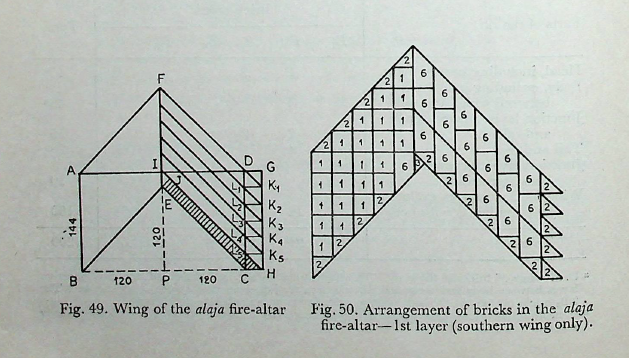
Fig. 49. Wing of the alaja fire-altar
Fig. 50. Arrangement of bricks in the alaja fire-altar - 1st layer (southern wing only).
The area of the wing south of the nirṇāma line EF is 33 pañcami and that of IECH \(\frac{33}{6}\) or \(5\frac{1}{2}\) pañcami. The first line of rule 13.6 prescribes that a triangular area EIJ measuring a quarter brick, that is \(\frac{1}{4}\) pañcami is to be added. In other words, the actual area to be removed is ECHJ measuring \((5\frac{1}{2} - \frac{1}{4})\) or \(5\frac{1}{4}\) pañcami; for two wings the area to be removed is 10 pañcami.
मूलम्
एवं पञ्च पञ्चम्यः सार्ध्या उद्धृता भवन्ति ५
विश्वास-प्रस्तुतिः
पादेष्टकामपनाम उपध्याय तासां चतुरश्र पाद्याः साष्टमभागा अपोद्धृत्य शेषं यथायोगं यथासङ्ख्यं यथाधर्मं चोपदध्यात् ६
English
1 quarter brick is placed at each western bend (to fill up the triangular void caused by the aforesaid removal). Out of the brick types the four-sided quarter bricks and the one-eighths are to be taken away, and the remaining space (of the fire-altar) is to be filled with (remaining types of) bricks such that these fit, the required number (of 200 bricks in the layer) is attained and the properties (of the fire-altar) are satisfied.
English
13.6. (remaining part). Placement of bricks in the two layers. For the placement of bricks, only \(B_{1}, B_{2}, B_{3}, and B_{6}\) as described for the kaṅkacit, are required and not \(B_{4}\) (aşṭami) and \(B_{5}\) (caturaśra-pādyā), because the fire-altar is without feet and \(B_{4}\) and \(B_{5}\) bricks are needed to cover them.
For the first layer, the placement of bricks in the head, the body and the tail is the same as that for the first layer of the kaṅkacit. The arrangement in the wing is shown in Fig. 50, and the number of bricks and their types used in the different parts are given in Table 11.
TABLE 11. Bricks in different parts of the alaja fire-altar—1st layer.
| Brick types | |||||
|---|---|---|---|---|---|
| Parts of the citi | B1 | B2 | B3 | B6 | Total |
| Head | 4 | 2 | 6 | ||
| Body | 48 | 8 | 56 | ||
| Tail | 12 | 6 | 18 | ||
| Wings and patras | 48 | 38 | 2 | 32 | 120 |
| ——————– | ————– | —- | —- | —- | ——- |
| Total | 112 | 54 | 2 | 32 | 200 |
D. states tatrāṭmani ṣaṭpañcāśat | ŝirasi ṣaṭ | pucche aṣṭādaśa | pakṣayorvimŝatiśatam | asminprastāre dvādaśaśatam pañcamyaḥ | catuḥpañcāśadardhyāḥ | dve pādye | dvātrimsada- dhyardhāḥ |
In the second layer, the arrangement of bricks in the head, the body, the two junction layers between the body and the wings and the junction layer between the body and the tail is the same as that of the kaṅkacit. In the tail also it is the same except at the end layer owing to the absence of the feet. This end layer is covered by 15 \(B_{3}s\) (Fig. 51).
In each wing (the southern one is here discussed), the arrangement is as follows:
(a) At the layer along the bending (nirṇāma), east-west-
\(B_{1} = 4 ; B_{3} = 1 ; B_{6} = 1;\) total—6
(b) In the 4 layers north of the nirṇāma, there are-
\(4 B_{6}s\) in each layer; total—16
(c) In the junction layer between wing and body——
\(B_{3} — 1 ; B_{6} = 4;\) total—6
(d) In the 4 layers south of the nirṇāma, each contains 2 \(B_{1}s\) in the middle, 1 \(B_{6}\) each at east and west end ——
\(B_{1} = 8 ; B_{6} -8;\) total—16
(e) In the plumages (patras), as in kańkacit-
\(B_{2}—5 ; B_{3} — 10;\) total 15.
The total for the southern wing, including the junction layer : 58
The total for the northern wing including the junction layer: 58
116
The arrangement of bricks in the wing and the tail is shown in Fig. 51. Table 12 gives the number and types of bricks used in different parts of the fire-altar.

Fig. 51. Arrangement of bricks in the southern wing and the tail, including the junction layers, of an alaja fire-altar-2nd layer (other parts not shown); (a) southern wing with junction layer with body, (b) tail with junction layer with body. TABLE 12. Bricks in different parts of the alajacit—2nd layer.
| Brick types | |||||
|---|---|---|---|---|---|
| Parts of the citi | B1 | B2 | B3 | B6 | total |
| Head, including part of body | 2 | 9 | 2 | 13 | |
| Body, excluding junction layers with wings | 35 | 4 | 4 | 431 | |
| Junction layer between body and tail |
1 | 2 | 2 | 5 | |
| Tail | 2 | 15 | 6 | 232 | |
| Two wings, including junction layers with body | 24 | 10 | 24 | 58 | 116 |
| total | 60 | 20 | 50 | 70 | 200 |
मूलम्
पादेष्टकामपनाम उपध्याय तासां चतुरश्र पाद्याः साष्टमभागा अपोद्धृत्य शेषं यथायोगं यथासङ्ख्यं यथाधर्मं चोपदध्यात् ६