विश्वास-प्रस्तुतिः
प्राग्वंशः षोडशप्रक्रमायामो द्वादशव्यासोऽपि वा द्वादशप्रक्रमायामो दशव्यासः १
English
The sacrificial chamber (prāgvamsa) is 16 prakramas long by 12 prakramas broad, or else 12 prakramas long by 10 prakramas broad.
मूलम्
प्राग्वंशः षोडशप्रक्रमायामो द्वादशव्यासोऽपि वा द्वादशप्रक्रमायामो दशव्यासः १
विश्वास-प्रस्तुतिः
तस्य मध्ये द्वादशिको विहारः २
English
(A length of) 12 prakramas is left in the middle between the sacrificial fires.
मूलम्
तस्य मध्ये द्वादशिको विहारः २
विश्वास-प्रस्तुतिः
त्रिंशत्पदानि प्रक्रमा वा पश्चात्तिरश्ची भवति षट्त्रिंशत्प्राची चतुर्विंशतिः पुरस्तात्तिरश्चीति महावेदेर्विज्ञायते । मानयोगस्तस्या व्याख्यातः । आहवनीयात्षट् प्रक्रमान्महावेदिः ३
English
According to tradition, the mahāvedi measures 30 padas or prakramas on its western side, 36 (padas or prakramas) along the east-west line and 24 (padas or prakramas) on its eastern side; how it is to be measured out has been explained. The mahāvedi is 6 prakramas from the āhavanīya (fire towards east).
मूलम्
त्रिंशत्पदानि प्रक्रमा वा पश्चात्तिरश्ची भवति षट्त्रिंशत्प्राची चतुर्विंशतिः पुरस्तात्तिरश्चीति महावेदेर्विज्ञायते । मानयोगस्तस्या व्याख्यातः । आहवनीयात्षट् प्रक्रमान्महावेदिः ३
विश्वास-प्रस्तुतिः
तत एकस्मिन्सदः । तद्दशकम् । उदक् स-प्तविंशत्यरत्नयः । अष्टादशेत्येकेषाम् ४
English
The sadas (shed) lies 1 prakrama from there (east of the western edge of the mahāvedi) and is 10 prakramas wide (in the east-west direction) and 27 aratnis, according to another opinion, 18 aratnis long in the south-north direction.
मूलम्
तत एकस्मिन्सदः । तद्दशकम् । उदक् स-प्तविंशत्यरत्नयः । अष्टादशेत्येकेषाम् ४
विश्वास-प्रस्तुतिः
ततश्चतुर्षु हविर्धानम् । तद्दशकं द्वादशकं वा मानयोगस्तयोर्व्याख्यातः ५
English
The havirdhāna (shed for the soma-vehicles) lies 4 prakramas (to the east) from there; it is a square of 10 or 12 prakramas; how it (such a square) is to be measured out has been explained.
मूलम्
ततश्चतुर्षु हविर्धानम् । तद्दशकं द्वादशकं वा मानयोगस्तयोर्व्याख्यातः ५
विश्वास-प्रस्तुतिः
यूपावटीयाच्छङ्कोरर्धप्रक्रममवशिष्योत्तरवेदिं विमिमीते । दशपदोत्तरवेदिर्भवतीति सोमे विज्ञायते । मानयोगस्तस्या व्याख्यातः ६
English
The uttara vedi is measured out at a distance of half a prakrama to the west of the pole of the yūpāvaṭa (sacrificial post fixed in pit). According to soma- sacrifice, the uttara vedi measures 10 padas; how it is to be measured has been explained.
मूलम्
यूपावटीयाच्छङ्कोरर्धप्रक्रममवशिष्योत्तरवेदिं विमिमीते । दशपदोत्तरवेदिर्भवतीति सोमे विज्ञायते । मानयोगस्तस्या व्याख्यातः ६
विश्वास-प्रस्तुतिः
चात्वालः शम्यामात्रोऽपरिमितो वा ७
English
The cātvāla (pit in the ground) measures 36 añgulas, or it may have any undefined measure.
मूलम्
चात्वालः शम्यामात्रोऽपरिमितो वा ७
विश्वास-प्रस्तुतिः
अथोपरवाः प्रादेशमुखाः प्रादेशान्तरालाः । अरत्निमात्रं समचतुरश्रं विहृत्य स्रक्तिषु शङ्कून्निहन्यात् । अर्धप्रादेशेनार्धप्रादेशेनैकैकं मण्डलं परिलिखेत् ८
English
The uparavas (holes over which the soma is ground) are each 1 prādeśa long, the distance between two of them being 1 prādeśa. A square of side equalling 1 aratni is made, poles are fixed at the (four) corners, and a circle of radius equal to half pradeśa is drawn (with each pole at the corner as centre).
मूलम्
अथोपरवाः प्रादेशमुखाः प्रादेशान्तरालाः । अरत्निमात्रं समचतुरश्रं विहृत्य स्रक्तिषु शङ्कून्निहन्यात् । अर्धप्रादेशेनार्धप्रादेशेनैकैकं मण्डलं परिलिखेत् ८
विश्वास-प्रस्तुतिः
सदसः पूर्वार्धाद्द्विप्रक्रममवशिष्य धिष्ण्यानां द्विप्रादेशो विष्कम्भस्तथान्तरालाः ९
English
Situated at a distance of 2 prakramas from the eastern half of the sadas (shed), the dhiṣṇya (fires) are each 2 prādeśas in diameter and separated from each other by the same distance (of 2 prādesas).
मूलम्
सदसः पूर्वार्धाद्द्विप्रक्रममवशिष्य धिष्ण्यानां द्विप्रादेशो विष्कम्भस्तथान्तरालाः ९
विश्वास-प्रस्तुतिः
आग्नीध्रागारस्य पार्श्वमानी पञ्चारत्निः १०
English
The side of the (covered) place for (kindling) the āgnīdhra (sacrificial fire) is 5 aratnis.
मूलम्
आग्नीध्रागारस्य पार्श्वमानी पञ्चारत्निः १०
विश्वास-प्रस्तुतिः
एतेन मार्जालीयो व्याख्यातः । तस्योदीचीं द्वारं कुर्वन्ति ११
English
Thereby the mārjāliya (covered place for cleansing sacrificial vessels) is explained; its door is made on the northern side.
English - comment
AREAS OF PRĀGVAMŚA, MĀHĀVEDI, SADAS, ETC., THEIR RELATIVE DISTANCES; CONSTRUCTION OF EKĀDAŚĨ AND AŚVAMEDHA VEDI, AND THE VALUE OF π
4.1-4.11. The areas of different chambers and vedis as given by Baudhāyana are tabulated below :
| Name of altar | Geometrical shape | Measurement |
|---|---|---|
| āgnidhriya | square | side =5 aratnis. |
| cātvāla | square | side=36 aṅgulas. |
| dhiṣṇas | circle | diameter= 2 prādeśas. |
| havirdhāna | square | side=10 or 12 prakramas. |
| mahāvedi | isosceles | face=24 padas, base =30 |
| trapezium | padas, altitude = 36 padas,; the units may be also in prakramas. | |
| mārjāliya | square | side = 5 aratnis. |
| prāgvaṁśa | rectangle | length = 16 prakramas, breadth =12 prakramas; or length = 12 prakramas, breadth = 10 prakramas. |
| sadas | rectangle | length 27 aratnis, breadth=10 prakramas ; |
The uparavā is a square of side 12 aṅg. or a circle of radius 6 aṅg. drawn within a square of side 24 aṅg. Two uparavās are generally placed together at a distance of 12 angulas.
The rites and ceremonies in connection with the construction of the above and various other altars are commonly found in the Taittiriya Samhitā and Śatapatha Brāhmaṇa, but any clear mention of their special magnitudes is very rare.
Baudhāyana has made categorical mention of spatial magnitudes besides the methods of construction here and there (Bśl. 7.9, Ãśl. 7.2.). Baudhayana has discussed the construction of the mahāvedi in the next rule. Āpastamba has specially treated the dimension, area and construction of mahāvedi (or saumiki vedi) in chapter 5 of his Apastamba-sulbasūtra. The mahāvedi has much older tradition and its method of construction is mentioned in the Śatapatha Brāhmaṇa (IX. 2.1.4).
As regards relative distance of other vedis within the mahāvedi it is known from the Baudhāyana sulba that the sadas is at a distance of 1 prakrama (or pada) from the western side of the mahāvedi, and the havirdhāna at a distance of 4 prakramas (or padas) from it, and in the eastern side of the havirdhāna, 9 prakramas (or padas) still remain. Hence the relative distance is 1 + 10 (sadas) + 4 + 12 (havirdhāna) + 9 (rest) 36. According to Mānava (Mśl. 3.1-3.3), this is 1 + 9 (sadas) + 4 + 12 + 10 = 36. In this connection it is important to note that the altitude of the mahāvedi is 36.
मूलम्
एतेन मार्जालीयो व्याख्यातः । तस्योदीचीं द्वारं कुर्वन्ति ११
विश्वास-प्रस्तुतिः
रथाक्षान्तराला यूपावटा भवन्तीत्येकादशिन्यां विज्ञायते । तस्या दशानां च रथाक्षाणामेकादशानां च प-दानामष्टाङ्गुलस्य च चतुर्विंशं भागमाददीत । स प्रक्रमः स्यात् । तेन वेदिं विमिमीते १२
English
The pits for sacrificial posts are (placed) at intervals of 1 akṣa (104 añgulas) and there are eleven of them as per tradition. The twentyfourth part of the sum of 10 akṣas, 11 padas and 8 añgulas is the prakrama. With this the altar is to be measured.
मूलम्
रथाक्षान्तराला यूपावटा भवन्तीत्येका-दशिन्यां विज्ञायते । तस्या दशानां च रथाक्षाणामेकादशानां च प-दानामष्टाङ्गुलस्य च चतुर्विंशं भागमाददीत । स प्रक्रमः स्यात् । तेन वेदिं विमिमीते १२
विश्वास-प्रस्तुतिः
अथाश्वमेधे विंशत्याश्च रथाक्षाणामेकविंशत्याश्च पदानामष्टाङ्गुलस्य च चतुर्विंशं भागमाददीत । स प्रक्रमः स्यात् । तेन वेदिं विमिमीते १३
English
For the aśvamedha (horse sacrifice), the twentyfourth part of the sum of 20 akṣas, 21 padas and 8 aṅgulas is the prakrama. With this the altar is to be measured.
मूलम्
अथाश्वमेधे विंशत्याश्च रथाक्षाणामेकविंशत्याश्च पदानामष्टाङ्गुलस्य च चतुर्विंशं भागमाददीत । स प्रक्रमः स्यात् । तेन वेदिं विमिमीते १३
विश्वास-प्रस्तुतिः
अथ प्राच्येकादशिन्यां यूपार्थं वेदेः पूर्वार्धात्प-दार्धव्यासमपच्छिद्य तत्पुरस्तात्प्राञ्चं दध्यात् । नात्राष्टाङ्गुलं विद्यते । न व्यतिषङ्गः १४
English
For the making of 11 pits along the eastern side, a strip of breadth half a pada is cut off from the eastern half of the mahāvedi and placed east of it in the east-west direction. In this (operation) 8 aṅgulas are not taken into account, and there is no mutual connection.
English
USE OF EKĀDAŚINĪ IN THE CONSTRUCTION OF MAHĀVEDI and Aśvamedha Vedi
4.12-4.14. In ekādaśini vedi there are 11 posts arranged in a row, each placed at a distance of 1 akṣa from its immediate next. The diameter of each hole in which the pole is placed is a pada, and a space of 4 aṅg. is left on both sides of the two end-poles. Hence the space covered equals 10 akṣa + 11 padas + 8 aṅg. that is, 1213 aṅg. For the construction of the eastern part (i.e. face) of the mahāvedi with 11 poles, the length of 1213 aṅg. is divided by 24 to calculate the value of each prakrama. The distance between the two poles is known as prakrama. The length of prakrama varies for enlarged altars. For this reason the length of prakrama in mahāvedi is different from that of aśvamedha vedi. Since the face of the mahāvedi is 24 prakramas, according to Dvårakānātha, one prakrama equals \(\frac{10x 104 11 x 15 + 4} {24}=50 aṅg.\) 18 tilas (approx.).
According to Kātyāyana (Kśl. 6.8-6.13), it is the 24th part of 11 paravān, 10 akṣa that is, 48 aṅg. 28 tilas (Mahidhara). Kātyāyana has not considered any space left beyond the two-poles. Mahīdhara has suggested 1 paravan to be 12 aṅg.; the pada according to Baudhāyana is 15 aṅg., while it is 12 aṅg. in other texts.
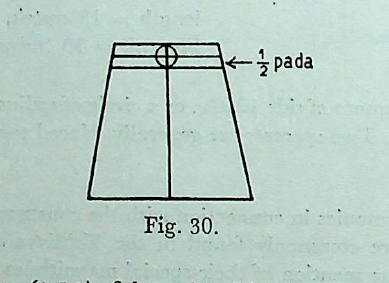
The east-west line (prāci) of the mahāvedi is likewise constructed with 11 poles. Only a rectangular block of half a pada is cut off from the eastern side of the altar and the end-pole is placed, so that half of the end-pole is to be considered inside the altar and half outside. For construction of east-west line, the extra 8 aṅg. that is left beyond the end-poles discussed above is not required in this case.
For the construction of the aśvamedha vedi, by the use of 21 poles, the value of each prakrama is taken to be 24th part of 20 akṣa + 21 padas + 8 aṅg. which is equal to \(\frac{20 × 104 + 21 × 15 + 8}{24} = 100\) aṅg 4 tilas (approx.).
मूलम्
अथ प्राच्येकादशिन्यां यूपार्थं वेदेः पूर्वार्धात्प-दार्धव्यासमपच्छिद्य तत्पुरस्तात्प्राञ्चं दध्यात् । नात्राष्टाङ्गुलं विद्यते । न व्यतिषङ्गः १४
विश्वास-प्रस्तुतिः
यूपावटाः पदविष्कम्भास्त्रिपदपरिणाहानि यूपोपराणीति १५
English
The pits for the sacrificial posts are 1 pada (each) in diameter; the circumference of the base of the pits is 3 padas.
English - comment
VALUE OF π
4.15. If d be the diameter of each hole (required in the construction of altar), and c its circumference, then according to this sūtra, (i) \(π = \frac{c}{d}=3.\)
This is undoubtedly a rough value known to the śulbakāras. In the problem of circling a square and quadrature of the circle, Baudhāyana has given three other values, which are a little better when compared with the correct value of π (= 3.14159…) as will be evident from the following:
(ii) \(π = \frac{4}{r^2}= 3.0883\)
where \(r = 1 + \frac{1}{3} {(\sqrt{2} — 1)};\)
(iii) \(π = 4 \left(1-\frac{1}{8}+\frac{1}{8.29}-\frac{1}{8.29.6.8}\right) = 3.0885\)
and (iv) \(π = 4 \left(1-\frac{2}{15}\right)^2 = 3.004\).
Dvārakānātha[^a] has, however, improved upon results (ii) and (iii) by introducing certain corrections as follows:
\(π \frac{4}{\left[1+\frac{1}{3}(\sqrt{2}-1)\right]^2} \times \left(\frac{118}{117}\right)^2=3.141109…\)
and \(π = 4\left(1-\frac{1}{8}+\frac{1}{8.29}- \frac{1}{8.29.6.8}\right)^2\times\left(1+\frac{1}{2}.\frac{3}{133}\right)^2 = 3.157991\)
मूलम्
यूपावटाः पदविष्कम्भास्त्रिपदपरिणाहानि यूपोपराणीति १५