English - comment
POSITIONS, RELATIVE DISTANCES AND AREAS OF SACRIFICIAL FIRES AND ALTARS
This and the following four chapters 4-7 deal with the positions, relative distances, and areas of various sacrificial fires and altars as also the types of bricks used in the construction of some of them. For a fuller appreciation of the details of mensuration presented by the śulbakāras in these chapters, a general idea regarding the plan of the sacrificial ground and the various fires and altars mentioned will be helpful. These details have been given at various places of the Brāhmaṇas, particularly of the Yajurveda school. Karavinda, the commentator of the Āpastamba-Śulba-sūtra has also made available a good summary.
PLAN OF THE SACRIFICIAL GROUND
The place for worship and performance of the various sacrificial rites is selected where the ground is high, even and firm, inclining towards the east or the north and rising towards the south.1 It should be spacious enough for the laying of the sacrificial hall, the mahāvedi and various pits, structures and elements required. After drawing the east-west line in the sacrificial ground, the sacrificial hall, the prācina-vamśa or prāgvaṁśa, as called by Baudhāyana, Kātyāyana and others, is erected at the western end, lying along, and symmetrically about, the east-west line (Fig. 26). The name is derived from the use of horizontal beams (vaṁśa) supported by four corner posts, on which corner beams are fastened to serve as lintels of the eastern and western doors.2 In this hall, besides the priests, the members of the family and friends of the person performing the sacrifice can assemble.
Inside this sacrificial hall are set up the gārhapatya fire at the western end, the āhavaniya fire at the eastern, the dakṣiṇāgni on the southern side more towards west and the utkara on the northern side more towards east. In between the āhavanīya
and the gārhapatya fire is placed the dārśapaurṇamāsika altar for the full-moon sacrifice or such other altars as may be required.
The gārhapatya is the householder’s fire received from his father and transmitted to his descendants. It is a perpetual sacred fire from which other sacrificial fires are lighted. This fire is used by the priests for cooking oblations.3 The āhavaniya is a consecrated fire taken from the householder’s perpetual fire and is also used for cooking oblations. The dakṣiņāgni, also called by the name of anvāhārya-pacana, is used for cooking food. Eggeling says that, at the new-and full-moon sacrifice, the anvāhārya mess of rice, the priest’s dakṣiņā, is cooked at this fire. The utkara placed near the north-east side of the sacrificial hall is a rubbish pit dug out in the ground.
East of the prāgvaṁśa and separated by a narrow space, the mahāvedi or the saumiki vedi (the soma altar) is placed symmetrically about the east-west (prācī) line. This is a trapezium measuring 30 units on the western side, 24 on the eastern side and 36 units east-west along the spine. The setting up of the mahāvedi is described in the Śatapatha Brāhmaṇa as follows (Eggeling’s translation)4:
“1. From the post which is the largest on the east side (of the hall) he now strides three steps forwards (to the east), and there drives in a peg,—this is the intermediate (peg).
-
From the middle peg he strides fifteen steps to the right, and there drives in a peg,-this is the right hip.
-
From the middle peg he strides fifteen steps northwards, and there drives in a peg,—this is the left hip.
-
From that middle peg he strides thirty-six steps eastwards, and there drives in a peg, this is the fore-part.
-
From the middle peg (in front) he strides twelve steps to the right, and there drives in a peg,—this is the right shoulder.
-
From the middle peg he strides twelve steps to the north, and there drives in a peg, this is the left shoulder. This is the measure of the altar.”
After the area of the mahāvedi is thus marked out, the sadas tent is erected near the western base of the mahāvedi. The tent is rectangular in area, the longer side lying south-north symmetrically about the east-west line, and is provided with doors on the western and the eastern side. This tent is reserved for the priests to sit
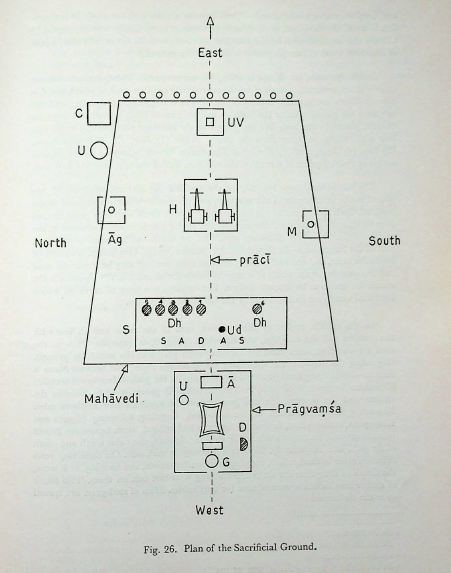
and conduct various operations:- “And because all the gods sat (sad) in it therefore it is called sadas—and so do these Brāhmaṇas of every family now sit therein.”5 Clearly the tent is divided by the prăci line into two parts. In the middle of it, a post of udumbara wood (Fiscus glomerata) is fixed to the ground.6:
Inside the sadas, six dhiṣnya hearths, Dh, are prepared. These are subordinate or side altars, generally a heap of earth covered with sand on each of which a fire is placed. There are actually eight dhiṣnyas, of which two, e.g., the āgnidhra and the mārjālīya are placed outside the sadas as will be seen in what follows. Of these six hearths placed in the tent, five are placed on the northern part parallel to the east side and belong, in order from the south to the (1) Hoty, (2) Brāhmaṇācchamsi, (3) Potr̥, (4) Neṣṭṛ, and (5) Acchāvāka. The dhiṣṇya hearth belonging to the Maitrā- varuṇa or Praśāstṛ priest is placed on the southern half of the tent near the east side.
The two other dhiṣṇya hearths, e.g. the āgnidhra, Āg, and the mārjāliya, M, are placed in the middle part of the northern and the southern side respectively of the mahāvedi. Both these hearths are set up under square sheds with four posts erected over them, open on the east side and the side facing the havirdhāna cart-shed in the middle of the altar. The Brāhmaṇa says: “In the north-with regard to the back part of the Soma-carts-he then raises the āgnidhra (shed). One half of it should be inside the altar, and one half outside; or more than one half may be inside the altar and less outside; or the whole of it may be inside the altar… “[^c2] Āgnidhra is the sacred fire and is to be thrown up first. The mārjāliya is a heap of earth on which sacrificial vessels are cleansed and is the last to be thrown up.
In the middle region of the mahāvedi, east of the sadas and in line with the āgnidhra and the mārjāliya, the havirdhāna shed, H, is erected. This is the shed for the Soma-cart used for carrying soma plants to the sacrificial ground. Regarding the derivation of the name, the Brāhmaṇa says: ‘And because Soma is therein-Soma being havis (material for offering) for the gods-therefore it is called Havirdhāna (receptacle of havis)’.[^d2] The cart-shed is provided with doors on the eastern and the western side and possibly on the southern and northern sides. Regarding the construction of the cart-shed, Eggeling, following Sayana and Katyayana, explains that, in front of the carts and behind them, beams are driven into the ground, six on each side.[^e2] The two middle ones, one cubit north and south of the prāci line respectively, forming a gateway on each side. On these two rows of beams other beams are laid, running from south to north, and forming, as it were, the lintels of the gates; the tie beams running west-east rest on them. This frame of timber is to form a square of nine (or ten) cubits. Mats of seed-grass are spread over the tie beams.
[^c2] Śat. Br. III. 6. I. 26.,
[^d2] Śat. Br. III. 5. 3. 2.
[^e2] Śat. Br. III. 5.3.9. Eggeling’s notes, SBE, 27, 128.
Uparavas are sounding holes dug out in the ground near the havirdhāna. The soma plants are ground over this hole, emitting the sound of the grinding stone, which gave it the name. The exact location of these sounding holes is not clear. The Śatapatha Brāhmaṇa says: ‘He digs just beneath the fore-part of the shafts of the southern cart.’[^a3] Karavinda says that the uparavas are located in the south-west corner of the southern part of the cart-shed,—dakṣiṇahavirdhānasya dakṣiṇaśroṇyāmuparavāḥ.
The uttara vedi, UV, is raised near the eastern side of the mahāvedi, with the prāci line passing through its middle. It literally means ‘higher or upper altar’ and so is likened to the nose of the sacrificer: ‘That high altar (uttara vedi) is the nose oft he sacrificer; because they throw it up so as to be higher than the altar, therefore it is called ‘high altar’.[^b3] The altar is built with the earth dug out of the cātvāla pit. This cātvāla pit is dug out at a little distance towards north from the north-east corner of the mahāvedi. The Brāhmaṇa says: “….and from where the northern peg of the front side is, he strides three steps backwards and there marks off the pit (cātvāla).’[^c3] It is of the same measure as that of the uttara vedi. Karavinda’s comments on the cātvāla is as follows: uttarasmādvedyamsādudakprakrame cātvāla uttaravedisammitaḥ. West of the cātvāla is the rubbish heap utkara, U. Eggeling has observed that the exact distance of the cātvāla is left to the discretion of the Adhvaryu priest, provided it is in front of the utkara and a narrow passage is left between them. He also says that the cātvāla pit should be contiguous to the north edge of the large altar, that is, the mahāvedi.
[^a3] Śat. Br. III. 5.4.3.
[^b3] Śat. Br. III. 5.1.12.
[^c3] Śat. Br. III. 5.1.26.
विश्वास-प्रस्तुतिः
अथाग्न्याधेयिके विहारे गार्हपत्यादाहवनीयस्यायतनम् । विज्ञायतेऽष्टषु प्रक्रमेषु ब्राह्मणोऽग्निमादधीतैकादशसु राजन्यो द्वादशसु वैश्य इति १
English
Now, the placement of the ahavaniya from the garhapatya in the arrangement for the laying of sacrificial fires (will be discussed). According to tradition, the Brāhmaṇa has to place this fire ( āhavaniya ) ( at a distance of) 8 prakramas, the prince 11 prakramas and the merchant 12 prakramas (from the gārhapatya towards east).
मूलम्
अथाग्न्याधेयिके विहारे गार्हपत्यादाहवनीयस्यायतनम् । विज्ञायतेऽष्टषु प्रक्रमेषु ब्राह्मणोऽग्निमादधीतैकादशसु राजन्यो द्वादशसु वैश्य इति १
विश्वास-प्रस्तुतिः
आयामतृतीयेन त्रीणि चतुरश्राण्यनूचीनानि कारयेत् । अपरस्योत्तरस्यां श्रोण्यां गार्हपत्यः । तस्यैव दक्षिणेंऽसेऽन्वाहार्यपचनः पूर्वस्योत्तरेंऽस आहवनीयः २
English
Three squares of side one-third the distance (between the āhavanīya and the gārhapatya) are made so as to be in contact with each other (along the east-west line); the gārhapatya (fire) lies at the north-west and the dakṣiṇāgni (anvāhāryapacana) at the south-east corner of the western square; the north-east corner of the eastern square marks the place of the āhavanīya.
मूलम्
आयामतृतीयेन त्रीणि चतुरश्राण्यनूचीनानि कारयेत् । अपरस्योत्तरस्यां श्रोण्यां गार्हपत्यः । तस्यैव दक्षिणेंऽसेऽन्वाहार्यपचनः पूर्वस्योत्तरेंऽस आहवनीयः २
विश्वास-प्रस्तुतिः
अपि वा गार्हपत्याहवनीययोरन्तरालं पञ्चधा षोढा वा सम्भुज्य षष्ठं सप्तमं वा भागमागन्तुकमुपसमस्य समं त्रैधं विभज्य पूर्वस्मादन्ताद् द्वयोर्भागयोर्लक्षणं करोति । गार्हपत्याहवनीययोरन्तौ नियम्य लक्षणेन दक्षिणापायम्य लक्षणे शङ्कुं निहन्ति । तद्दक्षिणाग्नेरायतनं भवति ३
English
Alternatively, the distance between the garhapatya and the āhavanīya is divided into five or six (equal) parts, a sixth or a seventh part is added, the whole (of the cord measuring the original distance plus the added part) is divided into three (equal) parts, and a mark is given at the end of the second part from the eastern extremity. (With two ties) fastened to (poles at) the two ends of (the distance between) the gārhapatya and the āhavanīya, the cord is stretched to the south by the mark and a pole fixed at (the spot reached by) the mark. This is the place of the dakṣiņāgni.
मूलम्
अपि वा गार्हपत्याहवनीययोरन्तरालं पञ्चधा षोढा वा सम्भुज्य षष्ठं सप्तमं वा भागमागन्तुकमुपसमस्य समं त्रैधं विभज्य पूर्वस्मादन्ताद् द्वयोर्भागयोर्लक्षणं करोति । गार्हपत्याहवनीययोरन्तौ नियम्य लक्षणेन दक्षिणापायम्य लक्षणे शङ्कुं निहन्ति । तद्दक्षिणाग्नेरायतनं भवति ३
विश्वास-प्रस्तुतिः
अपि वा प्रमाणं पञ्चमेन वर्धयेत् । तत्सर्वं पञ्चधा सम्भुज्यापरस्मादन्ताद्द्वयोर्भागयोर्लक्षणं करोति । पृष्ठ्यान्तयोः पाशौ प्रतिमुच्य लक्षणेन दक्षिणापायम्य लक्षणे शङ्कुं निहन्ति । तद्दक्षिणाग्नेरायतनं भवति ४
English
Or else, the measure (between the āhavanīya and the gārhapatya) is increased by its fifth, the whole of it is divided into five parts, and a mark is given at the end of the second part from the western extremity. With two ties fastened to (poles at) the two ends of the east-west line (representing the distance between the two fires), the cord is stretched to the south by the mark and a a pole fixed at (the spot reached by) the mark. This is the place of the dakṣināgni.
मूलम्
अपि वा प्रमाणं पञ्चमेन वर्धयेत् । तत्सर्वं पञ्चधा सम्भुज्यापरस्मादन्ताद्द्वयोर्भागयोर्लक्षणं करोति । पृष्ठ्यान्तयोः पाशौ प्रतिमुच्य लक्षणेन दक्षिणापायम्य लक्षणे शङ्कुं निहन्ति । तद्दक्षिणाग्नेरायतनं भवति ४
विश्वास-प्रस्तुतिः
विपर्यस्तैतेनोत्करो व्याख्यातः ५
English
The utkara is explained by doing the opposite (that is, by reversing the cord and stretching it to the north).
English - comment
DISTANCE AND RELATIVE POSITION OF GARHAPATYA, AHAVANIYA, DAKṢIŅĀGNI AND UTKARA
3.1-3.5 According to Baudhayana, the āhavaniya is constructed at a distance of 8 prakramas from the gārhapatya fire, when it is made by 4 Brāhmaṇas. The distance is sometimes 11 or 12 prakramas for peoples other than the Brāhmaṇas and followed traditionally from the time of the Śatapatha Brāhmaṇa (Śat. Br. I. 7.3. 23-25). For finding the relative positions of gārhapatya, āhavaniya and dakṣiṇāgni fires, Baudhāyana has prescribed the following three methods :
First method.
Let A,G, and D stand for āhavaniya, gārhapatya and dakṣiņāgni fires. The distance AG is divided into three equal parts, and with each third part, three squares are drawn touching each other; then the north-west corner of the western square, south- east corner of the same square and north-east corner of the eastern square mark the places for gārhapatya, dakṣiṇāgni and āhavaniya fires respectively (Fig. 27). When A and G are interchanged the corresponding position of D i.e. U will denote the place for utkara. Kātyāyana has given a similar method for fixing the positions of A, G, D and U (vide Kśl. 1.11).
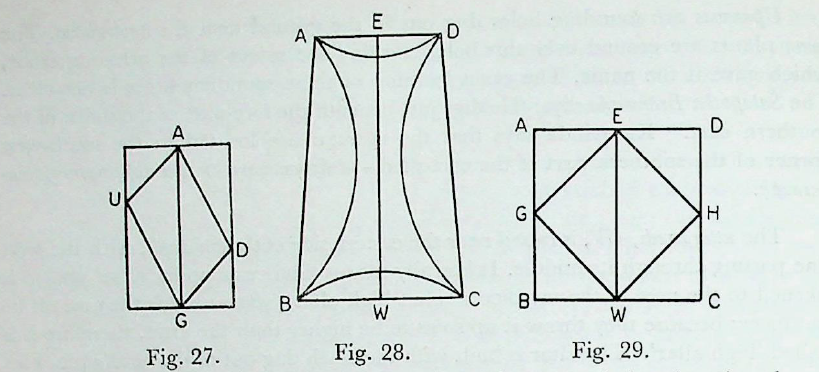
Here, if a be the distance between the gārhapatya and the āhavaniya, then
AD = \(\sqrt{(\frac{2}{3}a)^2+(\frac{a}{3})^2= \frac{\sqrt{5}}{3}a})
and \(GD = \sqrt{(\frac{a}{3})^2+(\frac{a}{3})^2=\frac{\sqrt{2}}{3}a}\)
Second method.
According to this method,
\( AD = \frac{2}{3}(a+\frac{a}{7})or \frac{2}{3}(a+\frac{a}{6})\)
\(= \frac{16}{21}a or \frac{7}{9}a\)
and \(GD = \sqrt{(\frac{a}{3})^2+(\frac{a}{3})^2}= \frac{\sqrt{2}}{3}a\)
Third method.
Here AD = \(\frac{3}{5} (a+\frac{a}{5})= \frac{18}{25}a\)
and GD = \(\frac{2}{5}\left(a+\frac{a}{5}\right)=\frac{12}{25}a\)
The second method is given by Āpastamba (Āśl. 4.4) and the first method by Kātyāyana (Kśl. 1.11).
From these three methods, the approximate values of \(\sqrt{5}\) and \(\sqrt{2}\) have been calculated by Datta7 as follows:-
\(\sqrt{5} = \frac{16}{7}, \frac{7}{3}, \frac{54}{25} = 2.285, 2.333,2.16\) respectively.
and \(\sqrt{2} = \frac{8}{7}, \frac{7}{6}, \frac{36}{25} = 1.142, 1.166, 1.44\) respectively.
The values \(\sqrt{5} = 2.285\) and \(\sqrt{2} = 1.44\) 1.44 are correct upto first place of decimal and others are fairly approximate values.
मूलम्
विपर्यस्तैतेनोत्करो व्याख्यातः ५
विश्वास-प्रस्तुतिः
अपरेणाहवनीयं यजमानमात्री+++(=९६ अङ्गुलानि, मत्-शरीरमानेन ~९८ अङ्गुलानि)+++ भवतीति
दर्शपौर्णमासिकाया वेदेर्विज्ञायते ६
English
To the west of the āhavaniya, as per tradition, is the altar for the new and full moon sacrifice (dārśapaurṇamāsa), measuring 96 aṅgulas (yajamānamātrī) (in the east-west direction).
मूलम्
अपरेणाहवनीयं यजमानमात्री भवतीति दर्शपौर्णमासिकाया वेदेर्विज्ञायते ६
विश्वास-प्रस्तुतिः
तस्यास् त्रिभागोनं +++(=९६-३२=६४ अङ्गुलानि)+++ पश्चात् तिरश्ची ।
तस्या एवार्धं+++(=४८)+++ पुरस्तात् तिरश्ची ।
एवं दीर्घचतुरश्रम्+++(=trapezoid)+++ एकतोऽणिमद् विहृत्य
स्रक्तिषु शङ्कून् निहन्यात् ७
English
This (measure) less its third (64 aṅgulas) forms the western side (of the altar) and half the measure (48 aṅgulas) the eastern side; after making in this way a rectangle shorter on one side, poles are fixed at the (four) corners.
मूलम्
तस्यास् त्रिभागोनं पश्चात् तिरश्ची ।
तस्या एवार्धं पुरस्तात्तिरश्ची । एवं दीर्घचतुरश्रम् एकतोऽणिमद् विहृत्य स्रक्तिषु शङ्कून् निहन्यात् ७
विश्वास-प्रस्तुतिः
यावती पार्श्वमानी द्विरभ्यस्ता
तावतीं रज्जुमुभयतः पाशां कृत्वा
मध्ये लक्षणं करोति ।
दक्षिणयोः पार्श्वयोः पाशौ प्रतिमुच्य
लक्षणेन दक्षिणापायम्य लक्षणे शङ्कुं निहन्यात् ।
तस्मिन्पाशौ प्रतिमुच्य लक्षणेन दक्षिणं पार्श्वं परिलिखेत् ।
एतेनोत्तरं पार्श्वं व्याख्यातम् ।
पूर्वं पार्श्वं तया द्विरभ्यस्तया परिलिखेत् ।
एवमपरम् ८
English
A tie is given at each end of a cord twice as long as the side (of the above altar) and a mark at the middle. With two ties fastened to (poles at the two ends of) the southern side, the cord is stretched to the south by the mark and a pole fixed at (the spot reached by) the mark. Fixing the two ties at this (pole), the southern side is circumscribed (with an arc of a circle from end to end) by the mark. Thereby the northern side is explained. The eastern side is circumscribed in the same way by a cord double its length, and likewise the western side.
English - comment
DARŚAPAURṆAMĀSIKA VEDI
3.6-3.8. The dārśapaurṇamāsika vedi is placed towards the west side of the ahavaniya and is in the form of an isosceles trapezium having face equal to 48 aṅgulas, base 64 aṅgulas and altitude 96 aṅgulas.
Here AD: = 48 angulas
BC 64 aṅgulas
and EW 96 aṅgulas.
A cord of length 2 BC is taken and a mark is given at its middle. Two ends of the cord are fixed at the southern poles A and B and is stretched towards south by the middle mark and a pole is fixed at it. Fixing two ends of the cord at this pole an arc is drawn through AB by the middle mark of the cord. Similar arcs are drawn in other sides. This is the vedi (Fig. 28).
This has been referred to in Ãśl. 4.5 and Mśl. 1.4. The vedi has a long tradition and is mentioned in the Taittiriya Saṁhita (II. 6.4. 2-3) and Taittiriya Brāhmaṇa (III. 2.9. 10).
नारायणाय्यङ्गार्यः
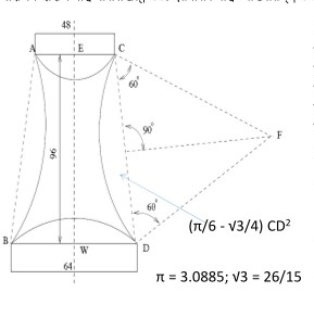
चतुर्भुजाकार ABCD क्षेत्रं = 5376 अङ्गुलानि तत्र अपाकरण क्षेत्रफलं 2032-2041 (अङ्गुलानि) अतः उद्दिष्ट वेदि क्षेत्रं = 3334-3345 अङ्गुलानि नेदीयेन 3339 +++(=sarosNum/2)+++ भवति ।।+++(5)+++
मूलम्
यावती पार्श्वमानी द्विरभ्यस्ता
तावतीं रज्जुमुभयतः पाशां कृत्वा
मध्ये लक्षणं करोति ।
दक्षिणयोः पार्श्वयोः पाशौ प्रतिमुच्य
लक्षणेन दक्षिणापायम्य लक्षणे शङ्कुं निहन्यात् ।
तस्मिन्पाशौ प्रतिमुच्य लक्षणेन दक्षिणं पार्श्वं परिलिखेत् ।
एतेनोत्तरं पार्श्वं व्याख्यातम् ।
पूर्वं पार्श्वं तया द्विरभ्यस्तया परिलिखेत् ।
एवमपरम् ८
विश्वास-प्रस्तुतिः
दशपदा पश्चात्तिरश्ची द्वादशपदा प्राच्यष्टापदा पुरस्तात्तिरश्चीति पाशुबन्धिकाया वेदेर्विज्ञायते । मानयोगस्तस्या व्याख्यातः । रथसम्मितेत्येकेषाम् । विराट्सम्पन्नेत्येकेषाम् ९
English
The tradition has it that the altar for animal sacrifice (pasubandha) has 10 padas on its western side, 12 padas as its east-west line (prācī) and 8 padas on its eastern side; how it is to be measured out has been explained. According to some, the altar is measured with the measures of a chariot (that is, with akṣa (104 aṅgulas) for the western side, iṣā (188 aṅgulas) for the prăci, and yuga (86 aṅgulas) for the eastern side). According to others, the sides are 10 padas each.
मूलम्
दशपदा पश्चात्तिरश्ची द्वादशपदा प्राच्यष्टापदा पुरस्तात्तिरश्चीति पाशुबन्धिकाया वेदेर्विज्ञायते । मानयोगस्तस्या व्याख्यातः । रथसम्मितेत्येकेषाम् । विराट्सम्पन्ने-त्येकेषाम् ९
विश्वास-प्रस्तुतिः
शम्यामात्री चतुःस्रक्तिर्भवतीत्युत्तरवेदेर्विज्ञायते । समचतुरश्राविशेषात् १०
English
According to tradition, the uttara vedi is four-cornered and measured (on each side) by a śamyā (36 aṅgulas); in the absence of any particular direction, it is a square.
English - comment
3.9-3.10. The paśubandha vedi is in the form of an isosceles trapezium whose face equals 8 padas, base 10 padas and altitude 12 padas. Sometimes the vedi is measured by akṣa, iṣā and yuga units of a chariot. The uttara vedi according to Baudhāyana is a square pit of side 10 padas.
मूलम्
शम्यामात्री चतुःस्रक्तिर्भवतीत्युत्तरवेदेर्विज्ञायते । समचतुरश्राविशेषात् १०
विश्वास-प्रस्तुतिः
वितृतीया वेदिर्भवतीति पैतृक्या वेदेर्विज्ञायते । महावेदेस्तृतीयेन समचतुरश्रकृतायास्तृतीयकरणी भवतीति । नवमस्तु भूमेर्भागो भवति । यजमानमात्री चतुःस्रक्तिर्भवतीत्येकेषाम् । दिक्षु स्रक्तयो भवन्ति ११
English
According to tradition, the paitṛki vedi (used for performing pitr-rites) is formed with the third part. The third part of the mahāvedi is turned into a square; the side which produces one-third of this square makes that (of the paitṛki vedi). Therefore, it is one-ninth of the area (of the mahāvedi). According to others, its side measures 96 aṅgulas (yajamānamātrī) and it is four-cornered, the corners being pointed to the four cardinal directions.
English
PAITṚKI VEDI
3.11. The paitṛki vedi is a square altar and its four corners are placed in four cardinal directions viz. east, west, north and south. The side of the paitṛki vedi is one-third of the units in mahāvedi, which is an isosceles trapezium of 972 sq. padas, having its face of 24 padas, base 30 padas and altitude 36 padas. Hence the corres- ponding units in paitṛki vedi are 8, 10, 12 and its area \(\frac{1}{2}(8 + 10) × 12 = 108)\ sq. padas. This justifies Baudhāyana’s statement that the paitṛki vedi is one-ninth in area of the mahāvedi.
Again, when one-third of the mahāvedi (i.e. sautrāmaṇiki vedi) is turned into a square, its side becomes 18 padas (Bśl. 3.12). Baudhāyana says in this rule that the side of the paitr̥ki vedi is \(\frac{18}{\sqrt{3}}\). This is also quite proper, for by the first method the side of the paitṛki vedi equals \(\sqrt{3}\) or \(\frac{18}{\sqrt{3}}\).
Kātyāyana, however, prescribes that in a square ABCD of 2 sq. purusas, the figure obtained by joining the middle poles E, G, W, H, that is the figure EGWH will be the required paitṛki vedi. The area EGWH is undoubtedly a square of 1 sq.
puruşa (Fig. 29). Here again the area varies from that of Baudhāyana but agrees with that of Āpastamba (Ãśl. 6.7-6.8). Though there is some difference in area, it is, however, a fact that the paitṛki vedi is a square pointing towards the cardinal directions.
मूलम्
वितृतीया वेदिर्भवतीति पैतृक्या वेदेर्विज्ञायते । महावेदेस्तृतीयेन समचतुरश्रकृतायास्तृतीयकरणी भवतीति । नवमस्तु भूमेर्भागो भवति । यजमानमात्री चतुःस्रक्तिर्भवतीत्येकेषाम् । दिक्षु स्रक्तयो भवन्ति ११
विश्वास-प्रस्तुतिः
वेदितृतीये यजेतेति सौत्रामणिकीं वेदिमभ्युपदि-शन्ति । महावेदेस्तृतीयेन समचतुरश्रकृताया अष्टादशपदा पार्श्वमानी भवति । तस्यै दीर्घकरण्यामेकतोऽणिमत्करण्यां च यथाकामीति १२
English
For performing the sautrāmaṇī sacrifice, the altar is advised to have an area one-third of the mahāvedi. If a third part of the mahāvedi is turned into a square its side will be 18 padas. It can also have, if one so desires, a shape in which one side is shorter and the other larger.
English - comment
SAUTRĀMAŅIKI VEDI
3.12. The rule of Baudhāyana suggests that the Sautrāmaņiki vedi may be a square of 18 padas or an isosceles trapezium whose area is one-third of that of mahāvedi, having area of 972 sq. padas. Baudhāyana made no explicit mention of how to construct an isosceles trapezium similar to a given isosceles trapezium but with one-third of its area.
Āpastamba (Ãśl. 5.8) constructed it with \(\frac{1}{\sqrt{3}}\) of the units used in mahāvedi or \(8\sqrt{3}\) and \(10\sqrt{3}\) as face and base and \(12\sqrt{3}\) as altitude. The mahāvedi is an isosceles trapezium having face 24, base 30 and altitude 36 units. Hence the sautrāmaṇikī vedi is an isosceles trapezium of face \(\frac{24}{\sqrt{3}}\) or \(8\sqrt{3}\), base \(\frac{30}{\sqrt{3}}\) or \(10\sqrt{3}\), and altitude \(\frac{36}{\sqrt{3}}\) or \(10\sqrt{3}\). Hence the area of the figure in the above two cases comes out as,
(i) \(\frac{1}{2}\left(\frac{24}{\sqrt{3}}+ \frac{30}{\sqrt{3}}\right)\times \frac{36}{\sqrt{3}}=\frac{1}{2}.\frac{54}{\sqrt{3}}.\frac{36}{\sqrt{3}}\)
and (ii) \( \frac{1}{2} ( 8\sqrt{3} + 10\sqrt{3}) \times 12\sqrt{3}=324\)
This equals one-third the area of a mahāvedi. The same method is also given by Kātyāyana (Kśl. 2.11-2.12).
मूलम्
वेदितृतीये यजेतेति सौत्रामणिकीं वेदिमभ्युपदि-शन्ति । महावेदेस्तृतीयेन समचतुरश्रकृताया अष्टादशपदा पार्श्वमानी भवति । तस्यै दीर्घकरण्यामेकतोऽणिमत्करण्यां च यथाकामीति १२