Jupter Saturn conjunction
A great conjunction is a conjunction of the planets Jupiter and Saturn (Κρόνος: Kronos). Kronos gives the measure of time to Jupiter. A Triple Conjunction is a conjunction of Jupiter and Saturn at or near their opposition to the Sun.
Periods
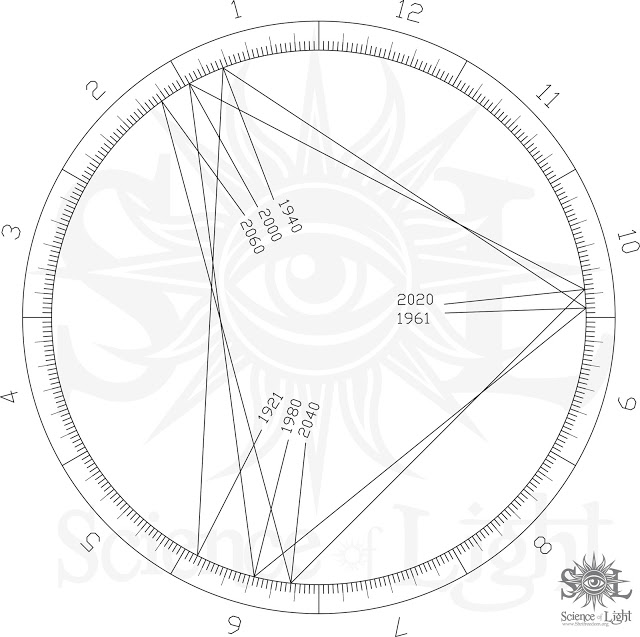
- Every twenty years (19.859), Saturn and Jupiter will have a conjunction at about 123 degrees apart (approximately ninth from the previous conjunction).
- Every 60 years (59.577) that conjunction will return to the same sign.
- If a conjunction happened in Aries, in twenty years, the next will happen in Sagittarius, then Leo in twenty more years, and then back to Aries after 60 years from the original Aries conjunction.
- In this way, the conjunctions will move in the same rAshi trines creating a triangle in the zodiac. … The cycle will stay in one rAshi trine for about 200 years, then it will enter the next rAshi triad. …
- The cycle will move through all the zodiac signs every 800 years (794.37 years or 40 conjunctions) returning to within .93° of the starting point if one uses a tropical calculation. (A given vertex will take ~800 years to reach the sign occupied by the next vertex, they being 4 rAshis apart.)
Connection to yugas
“This 1° discrepancy creates a larger cycle in which the exact degree returns in 288,000 years (800 X 360). In Satya Yuga there are 6 of these cycles, in Tretā Yuga there are 4.5, in Dvāpara there are 3, and in Kali Yuga there are 1.5 which gives a total of 15 of the grand 288,000 year cycles in a Mahāyuga.”
Jovian year
In the medieval era literature, a samvatsara refers to the “Jovian year” (59.577/60), that is a year based on the relative position of the planet Jupiter, while the solar year is called varsha. Rough calculation of jovian year length in days: 59.577/60*365 = 362.67. Surya Siddhanta calculates the Jovian year to be about 361.026721 days or about 4.232 days shorter than the tropical solar year.
This difference requires that about once every 85 tropical years (~ 86 jovian years, 86*4 ~ 344 days), one of the named samvatsara is expunged (skipped as a shadow year), to synchronize the two calendars.
Usage
From “The Indian calendar, with tables”
The years of Jupiter’s cycle are not mentioned in very early inscriptions. They are mentioned in the Sürya-Siddhanta. Dr. J. Burgess states that he has reason to think that they were first introduced about A.D. 349, and that they were certainly in use in A.D. 530. We have therefore given them throughout in Table I.
The southern (luni-solar) sixty-year cycle. The sixty-year cycle is at present in daily use in Southern India (south of the Narmada), but there the samvatsaras are made to correspond with the luni-solar year as well as the solar; and we therefore term it the luni-solar 60-year cycle in contradistinction to the more scientific Bårhaspatya cycle of the North.
There is evidence to show that the cycle of Jupiter was in use in Southern India before Saka 828 (A.D. 905-6); but from that year, according to the Arya Siddhanta, or from Saka 831 (A.D. 908-9) according to the Sürya-Siddhanta, the expunction of the samvatsaras was altogether neglected, with the result that the 60-year cycle in the south became luni-solar from that year. At present the northern samvatsara has advanced by 12 on the southern: There is an easy rule for finding the samvatsara according to the luni-solar cycle, viz., add 11 to the current Saka year, and divide by 60; the remainder is the corresponding luni-solar cycle year. It must not be forgotten that the samvatsaras of Jupiter’s and the southern cycle, are always to be taken as current years, not expired.
संवत्सराः
- १. प्रभवः,
- २. विभवः,
- ३. शुक्लः,
- ४. प्रमोदूतः,
- ५. प्रजोत्पत्तिः,
- ६. आङ्गीरसः,
- ७.श्रीमुखः,
- ८.भावः,
- ९.युवा,
- १०.धाता,
- ११ ईश्वरः,
- १२.बहुधान्यः,
- १३.प्रमादी,
- १४.विक्रमः,
- १५.वृषः,
- १६.चित्रभानुः,
- १७.स्वभानुः,
- १८.तारणः,
- १९.पार्थिवः,
- २०.व्ययः,
- २१.सर्वजित्,
- २२.सर्वधारी,
- २३.विरोधी,
- २४,विकृतिः,
- २५.खरः,
- २६.नन्दनः,
- २७.विजयः,
- २८.जयः,
- २९.मन्मथः,
- ३०.दुर्मुखी,
- ३१.हेविळंबी,
- ३२.विळंबी,
- ३३.विकारी,
- ३४.शार्वरी,
- ३५.प्लवः,
- ३६.शुभकृत्,
- ३७.शोभकृत्,
- ३८.क्रोधी,
- ३९.विश्वावसुः,
- ४०.पराभवः,
- ४१.प्लवङ्गः,
- ४२.कीलकः,
- ४३.सौम्यः,
- ४४.साधारणः,
- ४५.विरोधिकृत्,
- ४६.परीधावी,
- ४७.प्रमादीचः,
- ४८.आनन्दः,
- ४९.राक्षसः,
- ५०.नळः,
- ५१.पिङ्गळः,
- ५२.काळयुक्तिः,
- ५३.सिद्धार्थी,
- ५४.रौद्री,
- ५५.दुर्मुखी,
- ५६.दुन्दुभिः,
- ५७.रुधिरोद्गारी,
- ५८,रक्ताक्षी,
- ५९.क्रोधनः,
- ६०.अक्षयः।