Source: here.
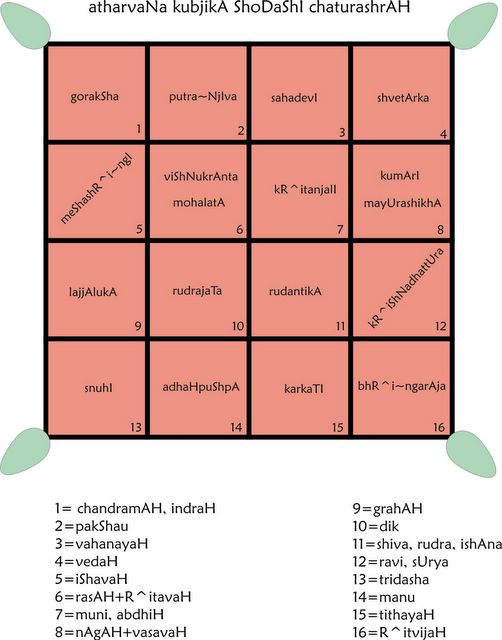
A stream of the kubjikA tradition has evolved out of the more archaic
atharvanic tradition. One of the most important links between the
kubjikA mata and the older atharvan tradition is the kubjikA
upaniShad.
kubjikA is identified with pratya~NgirA or atharvaNa bhadrakAlI the
spirit of the atharva veda. The kubjikA mata also preserves certain
other connections to the atharvan tradition in the form of the
medico-magical use of herbs. The kubjikA traditon deploys two famous
herb grids that are reminiscent of the herb collection used in the
atharvanic upAkarma or dIksha rite, the herb collection used for
consecrating and offering during the atharvaNa mahAshAnti and the most
exalted and awful dhUmAvatI rite of the atharvaNa kalpa. The first of
these is the 4X4 grid. These within the squares of this grid are placed
the following 18 oShadhis:
bhR^i~ngarAja (16), sahadevI (3), mayUrashikhA (8), putra~NjIva (2),
kR^itanjalI (7), adhaHpuShpA (14), rudantikA (11), kumArI (8), rudrajaTa
(10), viShNukrAnta (6), shvetArka (4), lajjAlukA (9), mohalatA (6),
kR^iShNadhattUra (12), gorakSha(1), karkaTI (15), meShashR^i~ngI (5)
and snuhI (13).
They are coded thus:
1= chandramAH; 2=pakShau; 3=vahanayaH; 4=vedaH; 5=bANa;
6=rasAH+R^itavaH; 7=muni/abdhiH; 8=nAgAH+vasavaH; 9=grahAH; 10=dik;
11=shiva; 12=ravi/sUrya; 13=tridasha; 14=manu; 15=tithayaH; 16=R^itvijaH
gorakSha(1)=Adansonia digitata
putra~NjIva (2)=Putranjiva roxburghii
sahadevI (3)=Conyza cinerea
shvetArka (4)= Calotropis procera
meShashR^i~ngI (5)= Gymnema sylvestra
viShNukrAnta (6)=Clitoria ternatea, Evolvulus alsinoides (?)
mohalatA (6) =Bergenia ligulata
kR^itanjalI (7)= Mimosa pudica
mayUrashikhA (8)= Adiantum caudatum
kumArI (8)=Aloe barbadensis/ Aloe vera
lajjAlukA (9)= Biophytum sensitivum
rudrajaTa (10)=Aristolochia indica
rudantikA (11)=Cressa cretica
kR^iShNadhattUra (12)=Datura fastuosa
snuhI (13)= Euphorbia species (E.neriifolia or E.nivulia)
adhaHpuShpA (14)=Trichodesma indicum
karkaTI (15)=Trichosanthes anguina
bhR^i~ngarAja (16)= Eclipta alba
Using this grid and numerical system various prescriptions may be coded
by the practioner. Thus, we are told of a prescription thus:
tri-dashAkShesha-bhujagair lepAt strI sUyate sukhaM ||
Which means: For easy delivery a woman may use a paste made from tri
(3); dasha (10); akShi (eyes=2); isha (rudra=11); bhujaga (nAga=8).
Some applications might have a magical slant: tithi-dig-yuga-bANaish cha
guTikA tu vasha~NkarI | bhakShye bhojye tathA pAne dAtavyA guTikA
vashe ||
This means: a pill made from tithi (15); dik (10); yuga (ages=4); and
bANa (5) can be used for vashikaraNa. This pill should be given in
eatables, food-stuff and drinks for the purpose of vashikaraNa.
R^itvig-grahAkShi-shailaish cha shastra-stambhe mukhe dhR^itA |
For protection against palsy on the face caused by stambhana prayogas
one may use R^itvik(16); graha (9); akShi (eyes=2); shaila
(mountains=7).
The second grid is a larger one of 6X6 squares (know as the grid of brahmA-rudra-indra), with 36 plants: (1) harItakI (2) akShi (3) dhAtrI (4) marIcha (5) pippalI (6) shlphA (7) vahni (8) ShuNThi (9) green pippalI (10) guDUchI (11) vachA (12) nimbakA (13) vAsaka (14) shatamUli (15) saindhava (16) sindhu-vAraka (17) kaNTakArI (18) gokShuraka (19) bilva (20) paunarnavA (21) balA (22) eraNDamuNDI (23) ruchaka (24) bhR^ingarAja (25) kShara (26) parpaTa (27) dhanyAka (28) jIraka (29) ShatapuShpI (30) javAnikA (31) viD~Nga (32) khadira (33) kR^itamAla (34) haridrA (35) vachA (36) siddhArtha
It seems vachA is reused twice in the grid. The plants are dried, ground to powder, treated with soma and mixed with jaggery into modaka, or mixed with ghee and some tailas for use. The recommended doses are from .5 karsha to 1 pala by weight.