Co-authored by Hari Ravikumar & R Ganesh
Introduction to Hinduism
Shatavadhani Ganesh December 7, 2019
(This is the first part of a series of articles on Hinduism.)
Hinduism is the major religion of India with a worldwide following of over a billion people. In its original and purest form, it is a sanātana dharma (loosely translated as ‘eternal truth’ or ‘timeless religion’) that represents at least 7,000 years of contemplation, tradition, and continuous development in India. One who follows Hinduism is called a ‘Hindu’ (the term originally referred to a person who lived beyond the Sindhu River, in undivided India). Hinduism has no single founder. Many ancient seer-sages, both men and women, contributed to its scriptures. Hindu scriptures are numerous and diverse. Most of them are written in the Sanskrit language. Sanskrit, like Latin, is the root language for several languages, and both Sanskrit and Latin belong to the same language family.
Śruti and Smṛti
The word ‘scripture’ is derived from the Latin scriptura, meaning ‘that which is written’ (thus also the strict adherence to what is written). The equivalent terms in Sanskrit for Hindu scriptures are śruti, ‘that which is heard’ and smṛti, ‘that which is remembered.’
_Ṛṣi_s (the seekers of truth, seers) of ancient India contemplated on creation, human nature, refinement of basic human instincts, purpose of life, working of the physical world, and the metaphysical dimensions of the universe.+++(5)+++ The collective contemplations of the _ṛṣi_s is called Veda. The literal meaning of the word veda is ‘to know’ or ‘knowledge.’
_Veda_s are the foremost and foundational scriptures in Hinduism. Every Hindu ceremony from birth to death, and beyond is drawn from the _Veda_s. There are four _Veda_s: Ṛgveda (consisting of _ṛk_s or verses), Yajurveda (consisting of yajus or prose), Sāmaveda (consisting of _sāman_s or songs), and Atharvaveda (consisting of sage Atharvan’s compositions). These together comprise the śruti texts. Though any body of knowledge can be called a Veda, like Āyurveda (the Veda of health), the term śruti applies only to the four _Veda_s.
The _ṛṣi_s taught this collected wisdom to their disciples, who in turn taught it to their disciples. Thus, this knowledge was passed on, intact, for many generations, without a single word being written down. Even today, traditional students learn _Veda_s orally from a guru (teacher). A verse from the Ṛgveda (X.191.2) poignantly captures the intellectual atmosphere of those times:
Come together, speak together,
Let your minds be united, harmonious;
As ancient gods unanimous
Sit down to their appointed share.
The final portion of the _Veda_s, called _Upaniṣad_s or Vedānta, contains anecdotes, dialogues, and discussions that deal with body, mind, soul, nature, consciousness, and the universe. Of the several _Upaniṣad_s, ten are recognized as the most important: Īśa, Kena, Kaṭha, Praśna, Muṇḍaka, Māṇḍūkya, Taittirīya, Aitareya, Chāndogya, and Bṛhadāraṇyaka.
Post Vedic Corpus
Post-Vedic texts form another set of scriptures, the smṛti, which were composed by a single author and later memorized by future generations. The term smṛti is also used while referring to the dharmaśāstra texts in general and to the works of sages like Manu, Parāśara, etc. in particular.
The _smṛti _texts include the Rāmāyaṇa and Mahābhārata (the epics or Itihasa), Aṣṭādhyāyi (grammar), Manusmṛti (law), Purāṇa (old episodes), Nirukta (etymology), ŚulbaSūtras (geometry), GṛhyaSūtras (running a family), and a whole body of texts governing architecture, art, astrology, astronomy, dance, drama, economics, mathematics, medicine, music, nutrition, rituals, sex, and warfare, among others.
The Bhagavad–Gītā (or simply ‘Gītā’), which is a small part of the epic Mahabharata, is an important and widely read scripture of Hinduism. It is one of the most comprehensive summaries expounding the core philosophy of Hinduism.
Creation, God, and Time

The Sanskrit word for Creation is sṛṣṭi, which means ‘pouring forth.’ It is not ‘creation’ but rather an outpouring, an expansion, a change. The idea of creation is discussed in different ways in the Vedas.
The celebrated hymn Nāsadīya Sūkta proposes a brilliant conceptual model for creation while another, the Hiraṇyagarbha Sūkta raises and answers many questions about god and creation. Yet another hymn, the Puruṣa Sūkta describes in detail the process of creation. Amidst all these varied views, there is a single underlying idea: ‘one became everything.’
Another contention is that the concept of god is subsequent to creation. Hinduism has many gods but only one Supreme or Universal Spirit. The _Veda_s make a clear distinction between god and Brahman, the Supreme Spirit, which is beyond all creation and destruction.
In Hinduism, god can either have a form or can transcend form. Among the gods with form, there are many varieties: gods can be male, female, half-male and half-female, or in the form of various animals, birds, mountains, trees, planets, stars, and other elements of nature.
Hindu Conception of Time
The Hindu timeline spans trillions of years and time is considered cyclical rather than linear. So we have eternal time cycles one after the other with no beginning or end. The Sūrya Siddhānta, a treatise of Hindu astronomy explains the staggering timeline:
…twelve months make a year
This equals a day and night of the gods (1.13)
360 days and nights of the gods make a divine year (I.14)
12,000 divine years make one mahāyuga. (I.15)
_A day of Brahma spans 1,000 mahāyuga_s
A night of Brahma also spans 1,000 mahāyuga_s._ (I.20)
Brahma’s life span is 100 Brahma years. (I.21)
Amāhayuga (Great Age) is made up of four yuga_s (Ages), viz., Satyayuga, Tretayuga, Dvāparayuga, and Kaliyuga. In human terms, a_māhayuga is 4.32 million years. A day of Brahma (the god of creation), spanning a thousand _mahāyuga_s, equals 4.32 billion human years, which is the time he is active and thus enables activity in the universe. This period is called a kalpa (cosmic cycle). During the night of Brahma, all creatures are dissolved only to be brought forth again at the beginning of the next day (i.e. the next kalpa).
The Hindu Conception of Space
The notion of space is similarly superlative in Hinduism. Traditionally, the universe is divided into three realms – earth, sky, and heaven, but there are other kinds of divisions of space. The Mahāsaṅkalpa (one of the traditional texts on rituals) talks of fourteen worlds – seven above and seven below, with the middle one being the earth – in the anantakoṭibrahmāṇḍa (the infinite cosmos).
On the earth, it identifies seven _dvīpa_s (islands); each dvīpa is divided into nine _varṣa_s (subcontinents); each varṣa is divided into nine _khaṇḍa_s (provinces). It also mentions ten forests, thirty-five rivers (seven main rivers with five tributaries each) and several mountains that are found in India (jambūdvīpa, bharatavarṣa).
Sects, Values and Ethics

Hindu sects are many and they often follow their own set of traditions and customs. While they seem very divergent, they have an underlying unity. Hinduism provides complete freedom and openness with regard to beliefs, practices, and philosophies of its followers.
We can take the example of belief in god: some Hindus believe in one god while some others believe in many; some believe in god with a form, some others believe in god who transcends form, while others are what can loosely be called agnostics.
Hindu values include harmony, tolerance, righteousness, respect for nature, and respect for the supreme. Hinduism accepts other religions and modes of thought. Here are two verses from the Ṛgveda saṃhitā that bring out these values very nicely:
May noble thoughts come to us from every side,
Unchanged, unhindered, undefeated in every way;
May the gods always be with us for our gain and
Our protectors caring for us, ceaseless, every day. (I.89.1)
The truth is one; the wise call it by different names. (I.164.46)
The Hindu worldview emphasizes conduct more than creed, and individual realization of truth is placed above dogma. Thus the contention that one need not read the _Veda_s to know the _Veda_s. Further, there is a notion that knowledge has to pertain to the time and location (every kalpa has its own Veda and every province has its own rules). The spirit of the _Veda_s will remain the same but the form will keep changing. A practical manifestation of this notion is the freedom to add a _khilasūkta _to the _Veda_s. These _khilasūkta_s –Śrī Sūkta for example – are later additions done to the Vedas to ensure that it remains relevant for the times.
Hinduism celebrates the diversity of existence and embraces the world as part of a big family, as recorded in an ancient book of stories, the Hitopadeśa (1.3.71):
“These are my own, those are strangers” –
Thus the narrow-minded ones judge people.
But for those magnanimous hearts,
The world is but one family.
The _Veda_s call humans by a cheerful and hopeful name: ‘the children of immortal bliss’ (Ṛgveda saṃhitā X.13.1). We are born pure and perfect but over time we accumulate the dust of unhappiness and pettiness. The constant quest is to return to our true nature as children of bliss. A prayer from the Bṛhadāraṇyaka Upaniṣad (I.3.28) talks about the spiritual journey from ignorance to illumination:
Lead me from falsehood to truth,
Lead me from darkness to light,
Lead me from death to immortality.
Hinduism is perhaps the oldest, most diverse, and most sophisticated system of religious thought and practice, covering nearly everything that comes under the umbrella of religion and philosophy. A human lifetime is insufficient to exhaust the wisdom it has to offer, and accessing even a small portion of this vast treasure enthralls, enriches, and elevates.
(Adapted from The New Bhagavad-Gita by Dr.Koti Sreekrishna and Hari Ravikumar)
Foundations of Hinduism
In its original and purest form, Hinduism is sanātana dharma, loosely translated as ‘eternal truth’ or ‘timeless religion’ or ‘eternal way of life’ or ‘timeless ethic.’ It is drawn from nature and thus unbounded by space-time constraints. However, in the several applications of sanātana dharma, we adopt specific spatio-temporal frames.
Sanātana Dharma
The word _sanātana _symbolizes eternity. From linguistic and cultural viewpoints, the word _sanātana _is a symbol of an unbiased, non-dogmatic, universal spirit. The word dharma does not have a proper equivalent in languages other than Sanskrit (or its derivatives). Its spirit can be loosely communicated in English with words such as ‘global ethic,’ ‘righteousness,’ ‘way of life,’ ‘culture,’ ‘principle,’ ‘law,’ ‘duty,’ etc. All these words put together signify the sustained implications of dharma. The term ‘Indian culture’ is a reasonable approximation to sanātana dharma.
Before going into the study of sanātana dharma, we shall begin a rational enquiry into values. Any faith or belief system should not be left unchallenged and we must screen it through rational enquiry and by gaining the universal experience first-hand.
Consciousness
Our perception of the world at different levels depends on us and therefore, the process of understanding depends on our mental and physical faculties. Thus our every enquiry in any field of our choice invariably presumes the self-evident existence of ourselves and proceeds from there on.
First: can we question our own existence? If yes, even such questions will be the product of our own existence. Therefore, our existence – irrespective of its kind – is eternal as far as we are concerned. Though our experiences in the wakeful state or even in the dream state are entirely different from place to place, time to time, person to person, and thought to thought, in sound sleep all of us have the same universal experience of absolute immersion and absolute detachment. Sleep is a highly refreshing and blissful state indeed.
None of the differences pertaining to natural or human-made divisions such as gender, race, age, nationality, or economic-social-cultural diversities are felt in deep sleep. Only in the states of wakefulness and dream do we have the baggage of ourselves. In the wakeful state, the sense organs and the mind are active but in the dream state, only the mind is active. Of course, it must be said here that we are speaking with a bias towards the wakeful state, because when we are inside a dream, we feel the existence of body and the overall physicality of the experience is indisputable.
In the state of sound sleep, neither the sense organs nor the mind are in action. However, there is no paucity of bliss. There is absolutely no inadequacy. It is a state of complete saturation. For our enquiry, we should start our analysis from this point. No study will become meaningful without a common or universal basis, such as this, to compare and contrast with any other experience. The _Upaniṣad_s start their self-enquiry with this analysis.
**Puruṣārtha**s
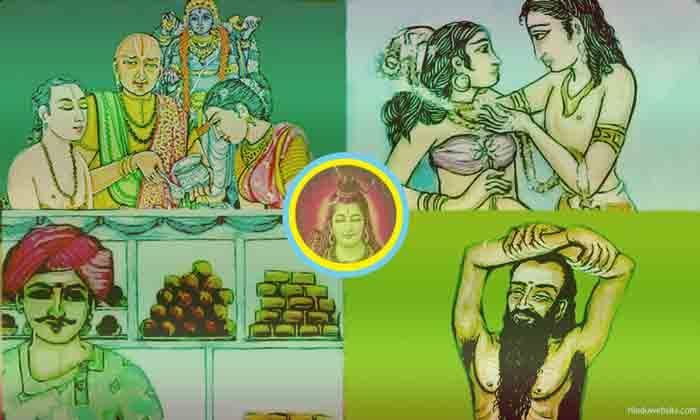
In deep sleep, there is no possibility for desires to arise. But in the dream and wakeful states, there is a great play of desires and dissolutions, proposals and disposals and agreements and disagreements.
Desire is the starting point of our individuality, or rather the feeling of our existence and identity. Desires drive us to action, which is essential to fulfil them. Desire stems from insufficiency, for it is the incompleteness within us that drives us to obtain something. In chemistry, unsaturated elements in terms of the number of electrons in their outermost orbit become chemically reactive and try hard to become saturated. This is the concept of valency of atoms. Similarly, our desires, according to their valencies, trigger action. According to traditional wisdom, this sequence of incompleteness leading to desire, eventually ending in activity is termed as the chain of avidya (ignorance), kāma (desire) and karma (action). Those who do not feel this incompleteness will not get caught in this downward spiral.
In the idiom of economics, desire leading to activity can be understood as demand leading to supply. In the long run, supply can never catch up with demand, for the human mind always harbours desires and demand is not constrained by materialistic limitations. This is not the case with supply. Typically, our desires get fulfilled in the material world and hence their existence is spatio-temporal in nature.
Desire, which is mental in origin and physical in manifestation, always has an upper hand over the things which try to satisfy it because the agencies which try to meet with the desire are constrained by matter, energy, space, and time. There will always be an acute shortage of supply against perpetual demand. We are aware that today we have the rapid depletion of natural resources at one end and an unlimited, ruthless world of desires eternally escalating at the other end. In sanātana dharma, the idea of demand and supply is conceived as kāma and artha. Kāma refers to desires and artha refers to the means of satisfying desire.
If desire goes on a rampage in a blind quest for gratification, the world will come to a standstill in seconds. This doesn’t happen because of the compromise – willing or unwilling – that we have made within and amongst ourselves. We agree to abide by the rules that we have ourselves set for the smooth functioning of our societies. This compromise evolves naturally, for, without it, our own existence is threatened. There is no doubt that such a compromise will not be pleasing to everyone; it is always the second-best choice in any situation (the best being what is solely convenient to us). The mode of implementation of this compromise will differ according to the frames of time, space, and mindset.
If this compromise is enforced from outside, it becomes a rule or an order. When it is realized from within, it becomes responsibility and awareness. Sanātana dharma calls this compromise, which is both a rule and a realization, as dharma.
These three concepts – kāma, artha, and dharma – are termed ‘trivarga’ (the group of three) and we may realize them in the physical world. The fourth concept, mokṣa (loosely translated as ‘liberation,’ ‘salvation,’ ‘release,’ etc.) is termed ‘apavarga’ (the separate group) and is treated separately from the other three since we have to annihilate desires and transcend the physical world in order to realize it. Mokṣa refers to liberation from the triangular frame of demand, supply, and compromise.
Hindu scriptures recommend, first of all, an efficient management of kāma/demand by using artha/supply by adhering strictly to dharma/compromise. This leads to a well-rounded life with its share of work and pleasure, neither losing calmness nor becoming stoic. By doing this, we will have prepared the ground for mokṣa.
These four core concepts – dharma, artha, kāma, and mokṣa – are together called the _puruṣārtha_s. In this context, the word puruṣa means ‘that which dwells in the body’ or ‘the self’ and artha refers to ‘the means’ to understand the self. This wonderful conception of _puruṣārtha_s retains relevance across time and place and transcends gender, race, nationality, religion, and political identity.
(This piece is co-authored by Hari Ravikumar)
Continued in the next part…
(The series was earlier published on indiafacts.org)
Classification of Dharma
Dharma is divided into two groups: sāmānyadharma (general or universal principles) and viśeṣadharma (special or particular principles). Sāmāyadharma includes all basic values which don’t change with space and time. They are applicable irrespective of distinctions of gender, race, caste, creed, occupation, nationality, etc. They comprise what we would call human values today – truth, non-violence, non-avariciousness, purity of thought, speech, and action, self-control, empathy, forgiveness and so on.
The sage-seer Manu defines dharma as having ten features: courage, forbearance, self-control, abstinence from stealing, cleanliness, control over senses, power of discernment, self-knowledge, integrity, and freedom from anger (Manusmṛti VII.92)
_Viśeṣadharma_s are spatio-temporal in that they are relevant only for a particular time and place. Some of the _viśeṣadharma_s are āśramadharma (the traditional duties of individuals at different stages of life), varṇadharma (the traditional duties of people of different temperaments), rājadharma (duties of rulers), and āpaddharma (duties and exemptions applicable during adverse situations). The specific injunctions of _viśeṣadharma_s are only relevant to a particular place and time but the general notions are universally applicable. For example, the rules that were laid down for a king might not be relevant today but the idea that governance needs guidelines will remain forever. The beauty of the Indian tradition is that there has been a constant re-interpretation of these concepts to suit the place and time. This subtle dynamism is what makes Hinduism a very robust way of life.
Irrespective of the category of dharma, the essential qualification for a true adherent of dharma is the constant accountability – here and now – of thought, word, and deed. There is no place for a preacher who does not practice when it comes to dharma. One of the words for teacher in Sanskrit is ācārya, which means one who himself adheres to the principles that he espouses. The ācārya is truly aware of what he is teaching. Indeed the aspects of learning, teaching, and practising merge in one who is a true ācārya.
Another interesting aspect of dharma in the Indian tradition is that it doesn’t blindly toe the line of morality. It judges from an ultimate perspective and not a mere materialistic one. For example, being honest normally refers to verbal sincerity and being non-violent refers to not hurting others. These values maybe transgressed for a greater cause – a son might lie to his aged mother to save her from a rude shock, a police officer might violate traffic rules while chasing a criminal, a surgeon might amputate a patient’s leg to save the latter’s life, a teacher might punish a student to help the latter mend his ways. Can these be counted as cases of dishonesty or violence? In cases like this, we naturally consider the intent of the people involved and the results of their action. In this regard, sanātana dharma upholds the actions of people who are selfless and self-realized with good intentions even if their chosen means are not ‘moral’ by the textbook definition.
There is a nice episode in the Karna Parva of the Mahābhārata where Arjuna and Yudhishthira are having a heated argument with regard to maintaining their oaths. Krishna pacifies them by giving them an exposition on the nature of truth and declares: “yad bhūtahitamatyantam tat satyamiti dhāraṇā” (truth is that which is good for all beings, that which is good at the universal level).
Fact and Value
The seers of ancient India gave importance to the implications of facts and values both within and outside the purview of mere faith. On the one hand, they did not completely exclude faith from philosophy and on the other hand, they did not try to explain everything within the narrow framework of faith. They approached facts and values from logical and intuitive, emotional and intellectual, practical and mystical, realistic and idealistic, and materialistic and spiritualistic perspectives. Therefore, their understanding of fact and value has been free from biases and are thus applicable universally.
What separates facts and values? We always comprehend facts readily because they are perceived through the senses. There is not much to discuss or argue with regard to facts. They are objective. We realize values through our experience and hence there arise several diverging opinions and views. They are subjective.
Facts deal with the outside world whereas values are intrinsic. If facts are what we encounter, values are what we reflect upon. If facts are grasped by the intellect, values are realized through experience.
Values are not ready-made or even fabricated like facts. Facts are an ever-growing body of data from the world around us. We rarely gather facts for the heck of it; facts are often used for purposes other than themselves. However, values are almost always pursued for their own sake. Further, once we understand a fact, it need not concern us or relate to our life. But that is not the case with values. Once a value has come within the grasp of our understanding, it has indeed, become a part of our experience. If that is not the case, then we have not truly realized the value but instead have only an idea that we’ve grasped with our intellect.
The non-materialistic nature of values makes them elusive in the material world. Values are not perceived through our physical senses but are felt in our consciousness. Let us take a simple example of a glass of water. Water is a fact and so is the glass. Where the water came from, and how the glass was fashioned, are also facts. But drinking the water and quenching our thirst is the realization of the value.
The Pillars of Indian Culture- Ṛta, Ṛṇa, Dharma
True realization of value takes us closer to the Vedic concept of ṛta. The word ṛta has no equivalent in English but can loosely be translated as the ‘cosmic order in the universe’, ‘divine law governing the universe,’ or ‘gnostic order that is inherent in the universe.’
The word ṛta is derived from the root word _ṛ _which means ‘dynamism,’ ‘vibrancy,’ ‘seasoning,’ and ‘belongingness.’ In the Vedas, ṛta is often held supreme. The Vedic god Varuṇa identified with water and the oceans is frequently referred to as the protector of ṛta. The symbolism of water and the ocean in connection with ṛta is profound.
In Ṛgveda and Arthavaveda, it is said that the law behind existence is ṛta and to tamper with it will prove deadly. The whole of creation is called _sat, _which has an inbuilt cosmic law, ṛta. If sat (existence) is a fact, then the value which we realize out of it is ṛta (cosmic law). When we realize ṛta, the value of the whole of creation, we are humbled and naturally become more caring towards the universe. The entire universe supports our sustenance and the whole of creation toils for our existence.
This awareness infuses immense gratitude in our hearts. This indebtedness—akin to guilt but without the negativity—that arises in a sensitive mind is called ṛṇa. (In common parlance, the word ṛṇa refers to ‘being in debt’ – of a physical, monetary kind.) In the Vedic conception, every human being by birth carries this baggage of ṛṇa. This baggage is not something mystical but rather straightforward.
Every birth is a miracle – the entire universe conspires to make it happen. Therefore, it is an unwritten duty to clear this debt to the universe. Without this, one will not achieve his or her life’s purpose. Those who ignore the debts they are born into are merely breathing, not alive. The way to clear this debt is by adhering to dharma. Thus, the awareness of ṛta leads to the realization of ṛṇa, which in turn motivates one to pursue dharma.
Yajña, Dāna, Tapas
Having realized that adherence to dharma is the ideal way to live, the question arises: how to practice it? The action plan of dharma is given in the pedagogy of yajña, dāna, and tapas.
Yajña is a specific term for the Vedic fire ritual. In general, it refers to worship of any form. Metaphorically, yajña refers to ‘an act of self-dedication,’ ‘service above self,’ or ‘respecting the divine presence.’ The word yajña comes from the root word yaj, which means ‘respect,’ ‘belongingness,’ and ‘sharing.’ Respect cannot last without a sense of belonging and this belongingness is not feasible without selfless offering.
A beautiful story in the Vedas will illuminate the true meaning of yajña:
The asuras (demons) – the elder brothers of the suras (deities) – went to their father Prajapati, the creator, and complained bitterly that they were often humiliated in comparison to their more illustrious younger brothers. They urged their father to find a solution to this problem and give them a better place. The great god Prajapati smiled and said, ‘O my children, you don’t know the essence of yajña and you don’t practice it even a bit. That is the reason you are compared with the suras and contemptuously dismissed by the wise.’ Needless to say, the asuras disagreed with his observation.
They dared Prajapati to give any test to the two groups of brothers and see who comes out as the winner. Prajapati agreed and so did the suras. He made all the suras and asuras sit on the floor and had a delicious meal kept in front of them. He asked them to eat, but with one condition, that they should not bend their elbows. The asuras were absolutely clueless; they failed miserably. How can you eat without bending your elbows?
But the suras were wise. They rearranged themselves so that they faced each other, keeping a distance of an arm. Then they fed each other, of course without bending their elbows. Then Prajapati told the asuras in a compassionate voice, ‘O my deprived children, this is the secret of yajña. Help the world without any expectations and share your prosperity with the rest. You will in turn be helped and enriched!’
When yajña comes into action for the welfare of mankind, it is known as dāna, or offering. The literal meaning of the word dāna is ‘giving,’ ‘charity,’ or ‘offering’ but the real import of the word is ‘philanthropy.’ While engaging in this act of giving, one must not be insecure, or have the feeling that one is losing something. This demands mental and physical preparation.
The training that leads to internal and external conditioning is called tapas. The term tapas translates into ‘penance,’ or ‘austerity,’ but mostly refers to a single-minded focus on work. Thus the threefold path of yajña, dāna, and tapas leads us to dharma.
The Nature of the Self
All of us, without exception, want to be happy – at all times and at all places. Happiness is our highest goal. All our suffering, struggle, and effort invariably are exercises towards the attainment of happiness. Happiness is the one point where all our diverging natures converge.+++(5)+++
The means by which one attains happiness varies from person to person. What constitutes happiness also varies similarly. In general, the source of happiness is considered to be one or more of the following: health, food, beauty, materials, money, fame, power, social status, art, travel, family, knowledge, love, etc.
Needless to say, what brings happiness to one might bring misery to another. But the very nature of happiness, the value, is not divergent. Our own experience reveals that happiness is a state of completeness where no inadequacy is felt.+++(5)+++ This state of fulfilment, though lasting for a moment, is essentially the same for everyone.+++(5)+++
Leo Tolstoy starts off his novel Anna Karenina with the words: ‘All happy homes are alike. But every unhappy home is unhappy in its own way.’ Joy has an absolute form while its opposite, sorrow, has many forms – and at a deeper level, they are all illusions.
This absolute state of joy is similar to the blissful experience of sound sleep. During sound sleep, all demands, desires, and differences disappear. Even the maladies of the body cease to exist during that time. This suggests that joy is innate but sorrow is externally thrust upon us. Our over-indulgence in the world brings sorrow.
Indeed, joy is also a product of external influences. But the happiness that we gain externally is short-lived and eventually leads to sorrow because it operates in the material world.+++(5)+++ But the bliss that we realize internally does not lead to sorrow. It is also interesting to note that sorrow cannot be generated internally, for our true state is bliss and not agony.+++(5)+++
Light, like happiness, is a positive entity whereas darkness is a negative one. Darkness doesn’t exist as an independent entity but rather, it is the absence of light. Sorrow, like darkness, has no independent existence. It is just the absence of joy.
When we ask someone ‘How are you?’ to enquire of their wellbeing, if the answer we get is ‘I am fine,’ then we will ask no more. But if the answer we get is ‘I am not fine,’ then we will have many questions for them. Similarly, if someone has learnt something that is of interest to us, we ask ‘How do you know that?’ or ‘How did you learn that?’ We would rarely ask ‘Why do you know?’
Don’t these instances reveal that existence, awareness, and happiness are natural states of every living being? Even in the physical world, we see concepts such as equilibrium, valency, and steady-state, pointing to a similar truth.
Irrespective of our physical or mental condition, we wish to live on forever, learn everything, have everything, and become fulfilled. The dying one seeks the elixir of life, the weakest one desires the gold medal, and the dullest one desires the top prize. All these are not merely desires driven by external forces but it is our inner nature that motivates us to seek wisdom and joy through these means.
In sum, our ultimate ambition is eternal existence, eternal awareness, and eternal happiness. Further, nobody truly wants to be a subordinate to another; in fact, everyone wants to dominate over the others. This desire for absolute freedom and absolute authority accelerates one’s zeal for eternity. This is the quest after perfection, as Prof. M. Hiriyanna calls it.
Sanātana dharma identifies this desire in a sublime way, considering this to be inbuilt in us as the very nature of our own selves. Absolute existence (sat), absolute awareness (cit), and absolute bliss (ānanda) that are independent of external factors constitute the nature of the self (ātman). The very nature of ātman is sat–cit–ānanda.+++(5)+++
The pursuit of attaining sat–cit–ānanda through materialistic paths leads invariably to corruption and annihilation. Those who seek existence, awareness, and bliss from outwardly sources try to establish authority over others. They declare their own freedom at the cost of other’s freedom and invariably become tyrants, blemishing humankind.+++(5)+++ Sat–cit–ānanda is not something to ‘attain’ but it is something to ‘realize,’ for it is always within.+++(5)+++
Sanātana dharma clearly distinguishes these two paths in the attainment of self-supremacy. It has always advocated the spiritual path, which is essentially inwardly and has shunned the path of materialism, which is always outwardly. However, we must remember that although sanātana dharma takes such a firm stand, it doesn’t take refuge in a utopia. It recognizes the materialistic world and gives it its due but encourages the evolution into the spiritualistic.
Materialism is an instrumental value, in that it is only a means and never an end in itself. This is why in the conception of the _puruṣārtha_s, the idea is to manage demand (kāma) and supply (artha) by the global compromise (dharma) in order to attain liberation (mokṣa). Materialism is inevitable but when pursued for its own sake without adherence to dharma and without the larger goal of mokṣa, it leads to destruction of the self and the surroundings. Mokṣa is the ultimate value. Ānanda, which is the very nature of mokṣa, is the fundamental value. All others are secondary and instrumental values.
Hinduism not only crystallized the concept of liberation but also established its instantaneousness. Liberation or salvation is not restricted to a post-death stage but can happen here and now. This brilliant conception is called jīvanmukti – being liberated during one’s lifetime. The Upaniṣadic conception of salvation is not a post-dated cheque but a demand draft.
Let us look at the idea of jīvanmukti with the lens of modern scientific temperament. Such an idea presupposes the futility of heaven, hell, divine judgement, apocalypse, etc. The highest ideal – liberation – can be attained by anyone, anywhere, anytime. It is within our reach. This is a great teaching.
But Hinduism never ignores individual accountability and sincerity in practice. It has the two opposite concepts of pāpa (sin) and puṇya (goodness, virtue). Everyone is expected to reduce their _pāpa_and increase their puṇya. We may explain the material implications of these two concepts using entropy, which is the measure of disorder or chaos in the universe. What recklessly adds to entropy is pāpa and what sincerely avoids entropy is puṇya.
There is no need to invoke any scripture or authority of any kind to follow the various points thus far. The reason for this is simple. Every religion claims that it is the most superior one and uses the revelations of its scriptures as authority. The proof provided and that which is to be proven is one and the same.
This is absurd, because any book – scripture or otherwise – is the product of the human mind, which is in turn conditioned by its own spatio-temporal limitations. While on the one hand, there is no need to disrespect any scripture, on the other hand it is imperative to transcend all scriptures. We can realize the one underlying spirit in all existence only with the universal experience of oneself, not by reading a book or listening to a lecture.
(Adapted from the article Foundations of Sanātana Dharma by Śatāvadhāni Dr. R Ganesh and translated from Kannada to English by K B S Ramachandra.)